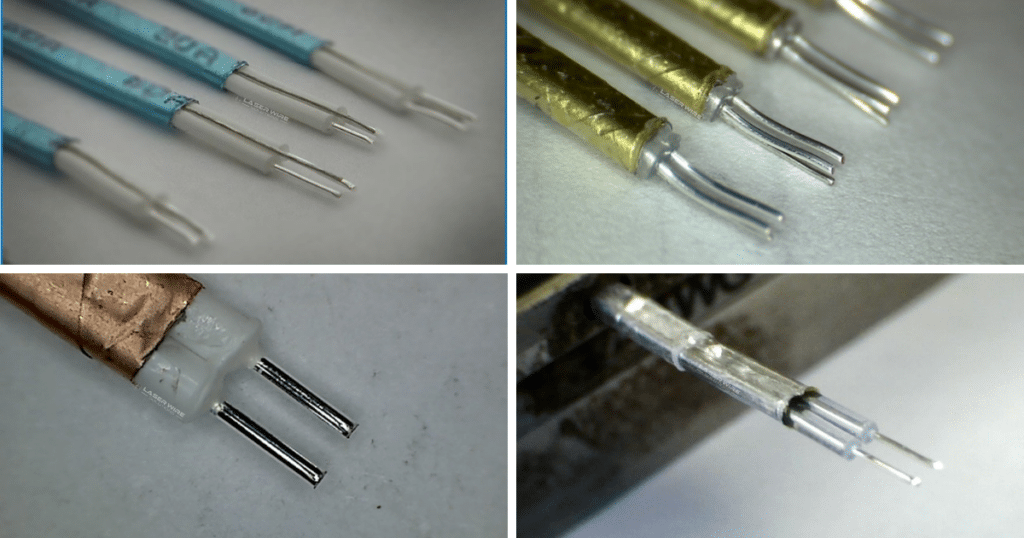
Twinaxial (twinax) cable is widely used in high-speed data transmission, interconnects, and signal-integrity-critical applications. Its geometry – two conductors within a shared shield – provides controlled impedance and strong noise immunity.
From a processing perspective, however, twinax presents specific challenges. Shield construction, dielectric material, and drain-wire configuration all influence how insulation and foil can be removed without damaging conductors or degrading electrical performance.
This article outlines the key technical considerations when stripping twinax cable and how laser-based approaches can be applied.
Twinax Construction and Processing Implications
Twinax cables typically fall into two broad construction categories:
Single-extruded twinax (with drain wire)
In this design, a foil shield surrounds the conductor pair and includes a drain wire for grounding and termination.
Processing considerations:
-
Risk of nicking the drain wire during shield removal
-
Variability in foil adhesion
-
Need to preserve electrical integrity of the drain
Laser processing allows the foil to be scribed rather than cut through, creating controlled break lines while avoiding drain-wire damage. This is particularly useful where the drain must remain intact for termination.
Co-extruded twinax (without drain wire)
Here, the shield is tightly bonded to the dielectric, with no drain wire present.
Processing considerations:
-
Shield adhesion reduces tolerance for over-processing
-
Foil removal relies on controlled peel initiation
-
Narrower process window
Precise depth control is required to initiate foil separation without disturbing the dielectric or conductors.
Jacket and Dielectric Materials in Twinax
Twinax cables use a wide range of polymers. Processing behavior varies significantly with material type.
Materials that typically process well
Jackets:
-
PVC
-
PE / HDPE
-
PU
-
TPE
Dielectrics:
-
Solid PE
-
Foamed PE
-
PP
These polymers can be removed efficiently with appropriate laser parameters.
Materials requiring tighter process control
Certain materials demand more conservative strategies:
-
Fluoropolymers (FEP, PTFE, ETFE)
-
Cross-linked or highly filled polymers
These can reflow, reflect, or char rather than ablate cleanly, often requiring lower power, higher speed, or multi-pass approaches.
Key Processing Risks in Twinax Stripping
Twinax cable performance depends heavily on conductor integrity and geometry. Processing therefore must avoid:
-
Partial foil cuts or tearing
-
Conductor nicks
-
Dielectric deformation
-
Melt-back or heat damage
Controlled laser strategies address these risks through:
-
Depth-tuned foil scribing
-
Multi-pass low-fluence removal
-
Heat distribution via scanning motion
-
Polymer removal without mechanical contact
These factors are critical for maintaining consistent strip quality and electrical performance.
Handling and Post-Processing Considerations
Twinax processing is not only about material removal. Handling and fixturing strongly influence outcomes.
Typical requirements include:
-
Repeatable cable positioning fixtures
-
Compatibility across processing stages
-
Controlled foil peel-off after scribing
-
Removal of dielectric slugs after stripping
Laser stripping removes material cleanly, but downstream handling must preserve cable geometry and cosmetic quality.
Process Development for Twinax Variants
Twinax is not a single-recipe cable type. Each construction requires parameter tuning.
A typical feasibility workflow includes:
-
Construction review
-
Jacket removal trials
-
Shield scribing trials
-
Dielectric stripping trials
-
Combined process optimisation
Stable, repeatable stripping depends on matching parameters to shield type, polymer behaviour, and dielectric structure.
Why Twinax Requires Controlled, Non-Contact Stripping
Twinax cables are used where signal integrity matters – including impedance, skew, and crosstalk performance.
Processing defects such as conductor nicks, dielectric damage, or shield deformation can directly affect these parameters.
For this reason, twinax stripping methods must prioritize:
-
Depth control
-
Conductor preservation
-
Thermal management
-
Repeatability
Laser-based approaches enable controlled material removal without mechanical contact, supporting consistent twinax preparation across constructions and materials.
Want to discuss a twinax project? Get in touch.