As automated catheter manufacturing becomes a strategic priority across the medtech industry, R&D and process engineering teams are facing a hard truth: legacy wire preparation methods are holding automation back.
The electrophysiology (EP) catheter market is already worth over $10 billion annually, growing at more than 11% CAGR, driven in part by innovation in Pulsed Field Ablation (PFA) . With Atrial Fibrillation affecting 1 in 4 people over 40 in their lifetime and increasing stroke risk by 500% , the race to scale catheter production is accelerating.
But here’s the problem.
Many catheter designs still rely on manual or mechanical wire stripping – a process fundamentally incompatible with scalable catheter automation.
The Industry Shift Toward Catheter Automation
The future of medical device manufacturing is unmistakably moving toward automation .
OEMs are under increasing pressure to:
-
Reduce reliance on skilled manual labor
-
Improve yield consistency
-
Launch products faster
-
Protect against regulatory and field failure risks
As highlighted in the latest Laser Wire Solutions whitepaper, the current model of manual assembly is already under strain, especially as innovation cycles accelerate and designs change frequently.
Today’s race is about launching cutting-edge technology first. But the long-term winner will be the manufacturer who can produce cost-effectively at volume.
Manual labor in lower-cost geographies is no longer a sustainable automation strategy.
True automated catheter manufacturing demands process steps that are:
-
Controlled
-
Validatable
-
Repeatable
-
Machine-compatible
Unfortunately, traditional wire stripping fails on all four counts.
Why Manual Wire Processes Block Automation
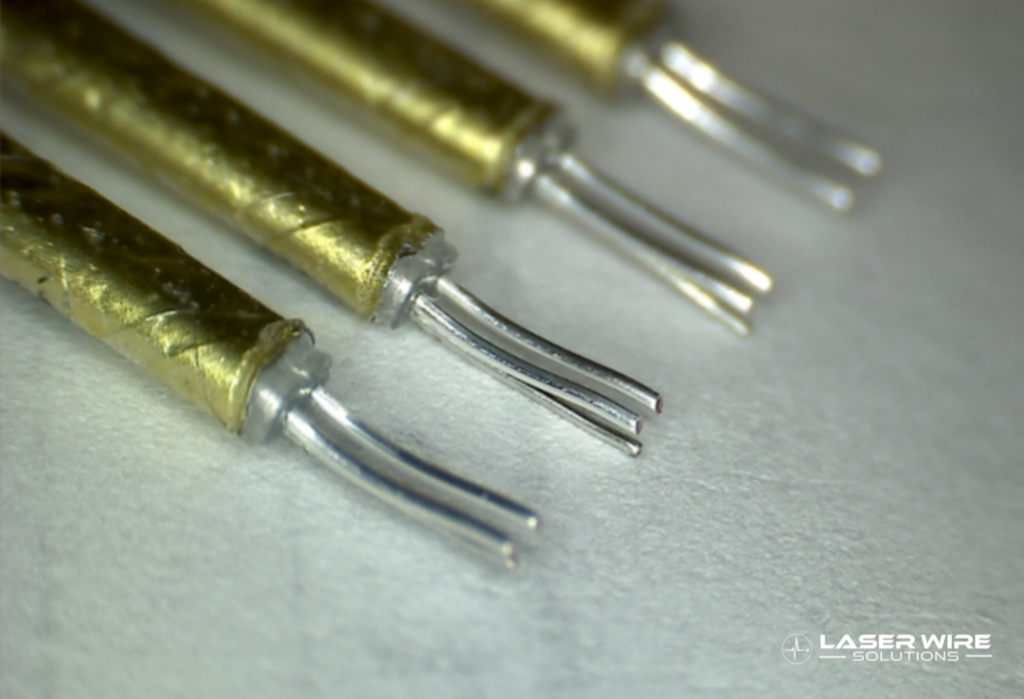
EP catheters contain between 5 and 50 microscopic wires, depending on design . These wires connect distal electrodes, sensors, and thermocouples to the proximal handle.
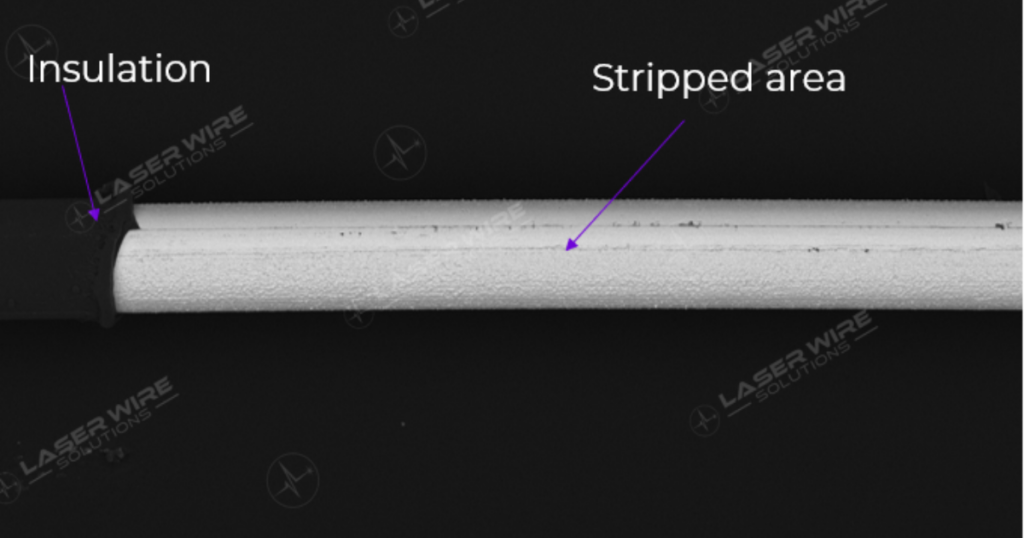
Each wire is coated in a thin insulating layer that must be removed at the connection point.
Historically, this has been done manually under a microscope using mechanical scraping tools.
This creates multiple automation barriers:
1. Operator Dependence
Mechanical stripping is entirely operator-dependent.
The technician must:
-
Judge pressure
-
Control timing
-
Rotate the wire 360°
-
Avoid conductor damage
Variability is inevitable.
Automation systems cannot replicate “feel.”
2. Validation Challenges
Manual stripping results vary by operator and cannot be fully verified post-process.
This makes robust validation extremely difficult.
In contrast, FDA 21 CFR 820.75 requires validated processes when outputs cannot be fully verified. The whitepaper states that only an automated, controlled method like laser stripping truly satisfies this intent.
Without validated stripping, automation initiatives stall at IQ/OQ/PQ.
3. Yield and Scrap Losses
Mechanical stripping can:
-
Weaken conductors by removing material
-
Leave residue that compromises welds and solder joints
Electrical failures are a primary source of expensive end-of-line scrap and field failures.
Laser stripping can typically reduce scrap by 1–2%.
With scrapped catheters costing $1,000–$2,000 each, savings can reach up to $1 million per line per year.
In one case study, doubling weld strength reduced failures by 1.5%, delivering $1.1M savings per line annually.
No automation roadmap survives 5% scrap rates.
4. Physical Incompatibility with Robotics
Mechanical stripping tools rely on:
-
Scraping blades
-
Abrasive wheels
-
Twisting actions
These are difficult to automate while maintaining micron-level precision.
The whitepaper states clearly:
Mechanical methods relying on operator skill are virtually impossible to automate while maintaining adequate quality.
That’s the core automation bottleneck.
Laser Processing as Automation-Ready Infrastructure
Laser wire stripping fundamentally changes the equation.
It transforms wire preparation from a manual craft into a controlled digital process.
How It Works
Laser stripping in EP catheters uses pulsed UV lasers delivering:
-
~10–20 µJ UV energy
-
~10 nanosecond pulse duration
-
Peak powers in the 1–10 kW range
Each pulse ablates insulation instantly, vaporizing it without heating or damaging the conductor.
Key automation advantages:
-
Pulse positioning controlled within microns
-
360° stripping without rotating the wire
-
Measurable, programmable parameters
This makes laser stripping:
-
Repeatable
-
Digitally controlled
-
SPC-compatible
-
Validation-ready
Laser stripping also achieved approximately 2x pull force compared to mechanically stripped wires in testing, directly strengthening downstream weld reliability.
Flexible Implementation Pathways
Laser stripping can be implemented in three automation-compatible formats :
-
Single-wire bench systems (<10 seconds per wire)
-
Fixture-loaded systems (strip up to 40 wires; 2–3 seconds per wire)
-
Pre-stripped wire supply on spools
The fixture-loaded systems are especially relevant for high-volume laser catheter assembly, enabling operators to load one fixture while another processes.
Pre-stripped wire removes stripping entirely from the line – ideal for early-stage automation programs.
Designing for Manufacture: Building Automation Into Catheter Architecture
Automation cannot be retrofitted easily into a catheter designed for manual processes.
As noted in the whitepaper, design for manufacture is not currently at the center of design – but it will be once technologies stabilize.
For catheter automation, this means:
-
Standardized wire lengths
-
Defined stripping geometries
-
Controlled surface finishes
-
Integration with welding and soldering robots
Laser processing supports this by:
-
Creating precise windows in multi-wire ribbons
-
Allowing partial cuts for segmentation
-
Enabling controllable surface roughness for improved solder wetting
Laser stripping works across common catheter materials including:
-
Polyamide-imide (PAI) / Polyester-imide (PEI)
-
Polyurethane
-
Nylon
-
Parylene
-
PTFE/ETFE (thin coatings)
It is compatible with copper, gold-coated, silver/tin plated, stainless steel, nitinol, platinum-iridium, and more – with no annealing or embrittlement observed .
This material versatility is critical for future-proofing.
The Future: Robotic Laser Catheter Assembly
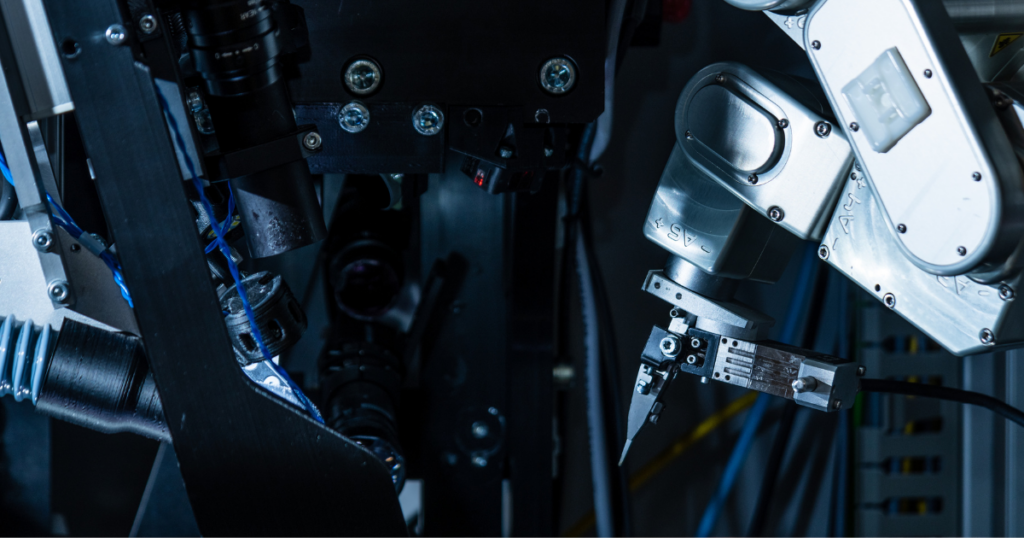
The whitepaper describes an experimental robotic laser stripping and soldering system that:
-
Sorts wires by electrical connection
-
Laser strips
-
Picks and places
-
Laser solders
-
Electrically tests
This represents the trajectory of automated catheter manufacturing.
Laser wire stripping is explicitly described as:
The only technology that can be automated at scale.
OEMs investing in laser stripping today are laying the groundwork for:
-
Semi-automated lines
-
Fully robotic catheter assembly
-
Reduced labor dependency
-
Scalable global manufacturing
Clinging to manual stripping not only hurts yields today, it leaves manufacturers behind as the industry automates .
The future of wire stripping is laser .
Frequently Asked Questions
1. Why is automated catheter manufacturing becoming essential?
Because market growth, innovation speed, and cost pressure demand scalable, validated production systems.
2. Why can’t mechanical stripping be automated effectively?
It relies on operator skill, pressure control, and tactile feedback, which are difficult to replicate with robotics while maintaining quality
3. Does laser stripping damage fine conductors?
No. Pulsed UV lasers ablate insulation without heating or weakening the conductor
4. What ROI can manufacturers expect?
Laser stripping can reduce scrap by 1–2%, potentially saving up to $1 million per line annually, with payback reported as well under 12 months
5. Is laser stripping compatible with common catheter materials?
Yes. It works with most insulation materials and conductor types used in EP catheters
6. How does laser processing support design for manufacture catheter strategies?
It provides programmable, repeatable stripping geometries that integrate directly into automated welding and soldering workflows
Automation Starts at the Wire
If you’re serious about catheter automation, start at the smallest – but most critical – component: the wire.
Manual processes may have built the industry. But they will not scale it.
Laser wire processing transforms stripping from an operator skill into a digital, validated manufacturing step enabling the transition to laser catheter assembly, robust design for manufacture catheter architectures, and fully automated catheter manufacturing.
The automation era is here.
The manufacturers who adapt first will lead it.