Every medical device manufacturer faces the same challenge: how to validate critical processes quickly, confidently, and at scale. Wire stripping – though a small step in the production line – often creates outsized delays and costs during validation. Operator-dependent techniques make it hard to prove consistency or document process parameters.
By switching to laser-based wire stripping, manufacturers can cut validation times, reduce audit risk, and lay the groundwork for automated, scalable production.
The Challenge to Validate Manual Wire Stripping
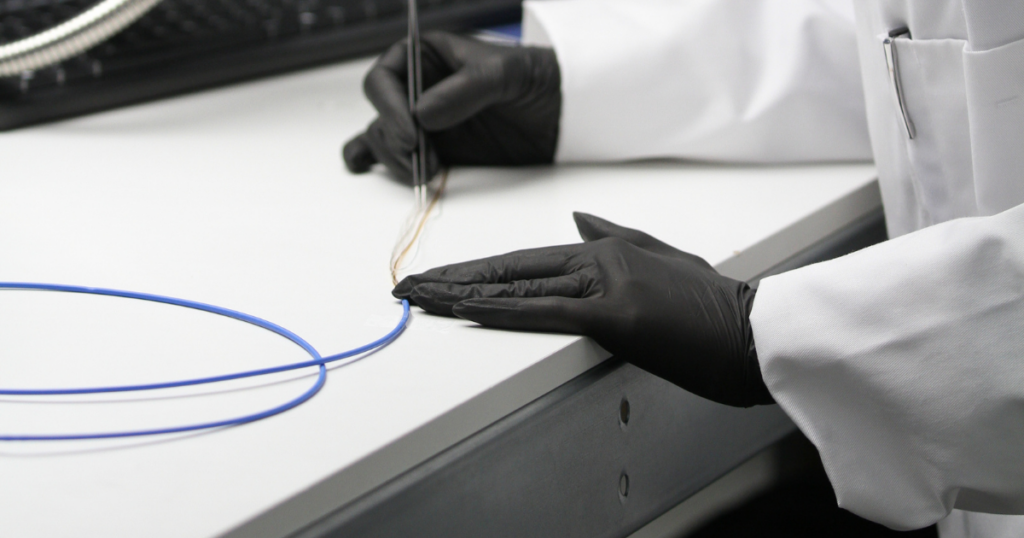
Manual or mechanical stripping still dominates many catheter and guidewire lines. Operators scrape or abrade insulation under microscopes, relying on touch, timing, and experience.
While skilled technicians can achieve acceptable results, the process itself introduces uncontrolled variability, the enemy of validation.
Under FDA 21 CFR 820.75, any process that cannot be fully verified by subsequent inspection must be validated to demonstrate consistent results. When a process depends on human dexterity, consistency is nearly impossible to prove.
The outcome is familiar to most medical OEMs:
-
Failed or extended IQ/OQ/PQ runs caused by variation in stripping quality.
-
Delays in market launch while engineers attempt to justify operator-dependent results.
-
High scrap and rework, consuming both time and material costs.
-
Compliance risk, with weak documentation or unverifiable data trails.
As one quality engineer summed it up:
“You can’t validate skill – you can only validate a process.”
Laser Wire Stripping: Validate the Process
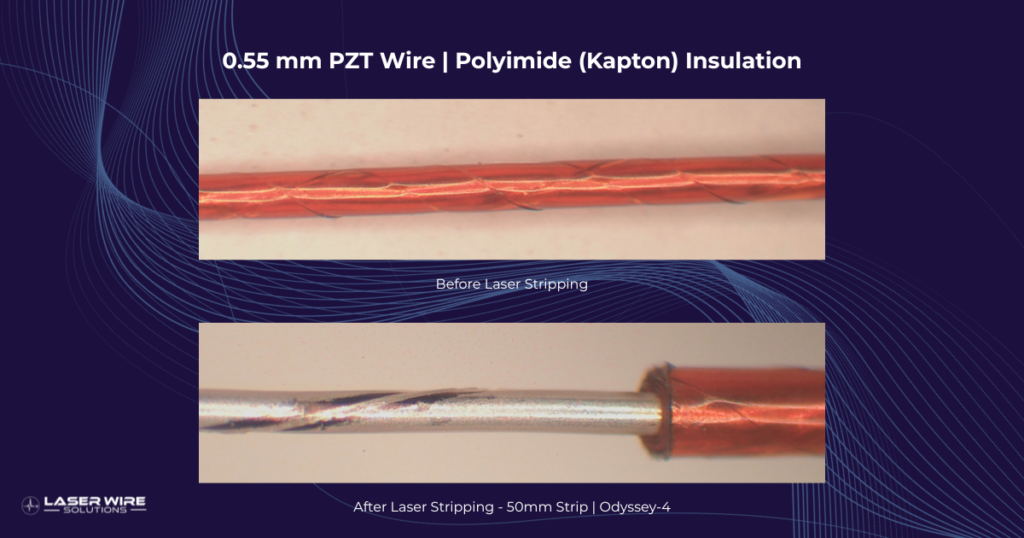
Laser wire stripping converts a subjective task into a controlled, measurable, and fully documentable process. Pulsed ultraviolet (UV) lasers remove insulation in micron-thin layers without physical contact or thermal damage. Each strip is defined by adjustable and traceable parameters – pulse energy, overlap, focus, and beam position.
That precision allows validation teams to qualify every stage with confidence:
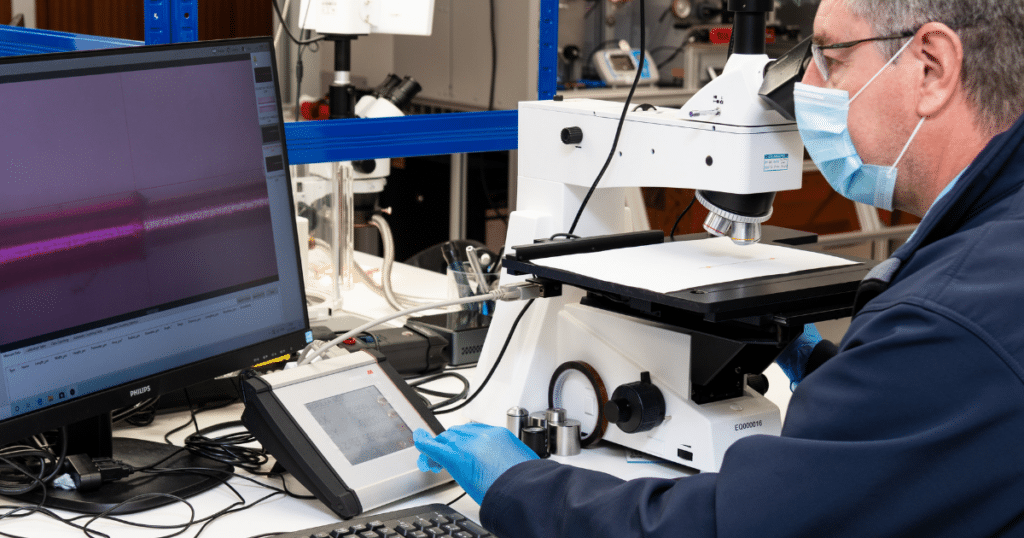
Installation Qualification (IQ) – verifies the machine configuration, calibration, and environment.
Operational Qualification (OQ) – confirms that laser parameters perform within defined limits.
Process Qualification (PQ) – demonstrates consistent, compliant results over full production runs.
Because each variable can be logged and locked, laser stripping meets both FDA and EU MDR requirements for special-process validation.
Quantifiable Quality and Business Value
Validated laser stripping doesn’t just simplify documentation; it improves measurable outcomes:
-
Higher first-pass yield through consistent insulation removal.
-
Shorter validation cycles thanks to controlled, repeatable settings.
-
Lower compliance risk via traceable data and stable performance.
-
Significant cost savings – manufacturers report over $0.5 million per production line annually from reduced scrap and rework.
In a regulated industry, validation confidence directly translates into competitive advantage. Early adopters of laser stripping gain both reliability and speed-to-market in fast-moving sectors like Pulsed Field Ablation (PFA) catheters.
Future-Proofing for Automation
Validated processes form the foundation of modern automation. Laser wire stripping systems integrate easily into semi- or fully automated cells, eliminating one of the last operator-dependent steps in catheter assembly. By standardizing the process today, manufacturers prepare for tomorrow’s automated lines – reducing cost per unit while maintaining full regulatory compliance.
Download the Full Whitepaper
This article covers only part of the story. Our in-depth whitepaper, Laser Wire Stripping of Cardiology EP Catheters: Achieving a Competitive Edge in the PFA Era, explores:
-
Detailed IQ/OQ/PQ validation methodology
-
Real-world ROI models and case studies
-
FDA-compliant process-development guidance
-
Future trends in automated catheter manufacturing
Get instant, free access to the whitepaper here.