Blade tools, abrasive cones, mechanical scraping remove insulation by physically contacting the wire. These approaches are familiar and widely used, but contact is also where variability enters the process, especially with fine medical wires.
Two issues come up again and again.
Small Damage That Has Real Consequences
Any mechanical contact carries the risk of nicking or scoring the conductor. Often the wire doesn’t break, so the damage goes unnoticed. But even a small reduction in cross-section can weaken fine wires and reduce their ability to handle downstream processes like welding, crimping, or over molding.
Over time, that loss of margin can turn into fatigue failures or unexpected breaks, sometimes long after the device has left the factory.
Insulation That Doesn’t Fully Go Away
Mechanical and abrasive stripping methods can also leave small amounts of insulation behind on the conductor. These residues are easy to miss, but they matter. Insulation left on the surface can interfere with electrical contact and make joining less consistent.
In resistance welding, for example, residual insulation can change how current flows at the joint, making it harder to form a strong, repeatable weld.
What SEM Images Make Obvious
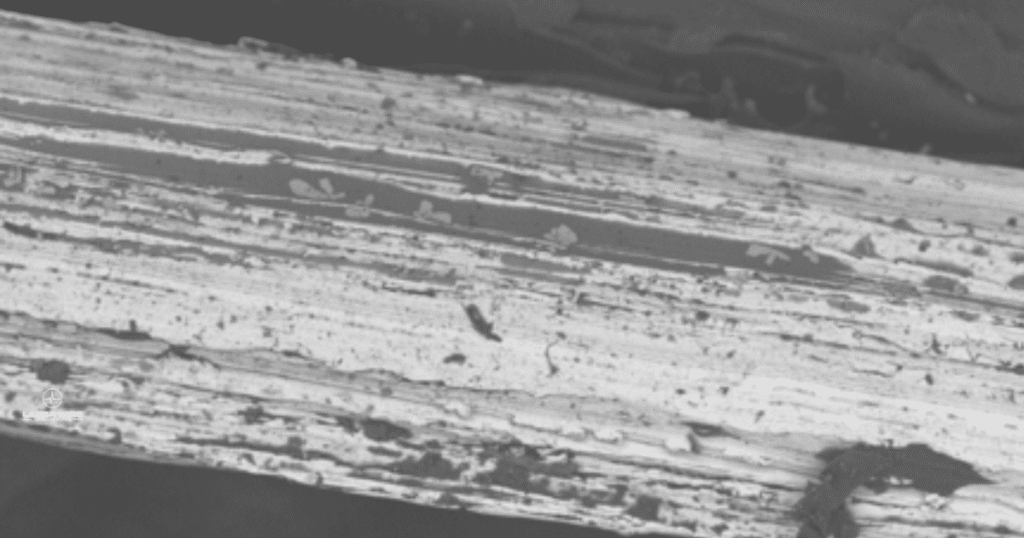
SEM imaging helps remove any guesswork.
-
Bright areas show clean, exposed conductor
-
Dark areas point to surface damage or remaining insulation
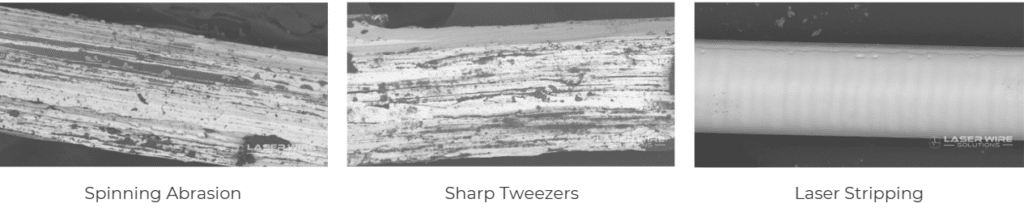
When wires stripped using mechanical tools are viewed under SEM, the surface often tells a mixed story. Clean metal sits next to damaged regions, and dark areas show where insulation remains.
If the damage is severe, the wire may fail during stripping or joining, and the problem gets caught. The bigger challenge is damage that falls just below that threshold. Those wires move forward in the process with reduced strength, and the risk shows up later.
Residual insulation creates a similar problem. Joints made on partially insulated conductors can pass initial testing but still be weaker and less reliable, increasing the chance of failure during handling, shipping, or use.
Why Laser Stripping Is Different
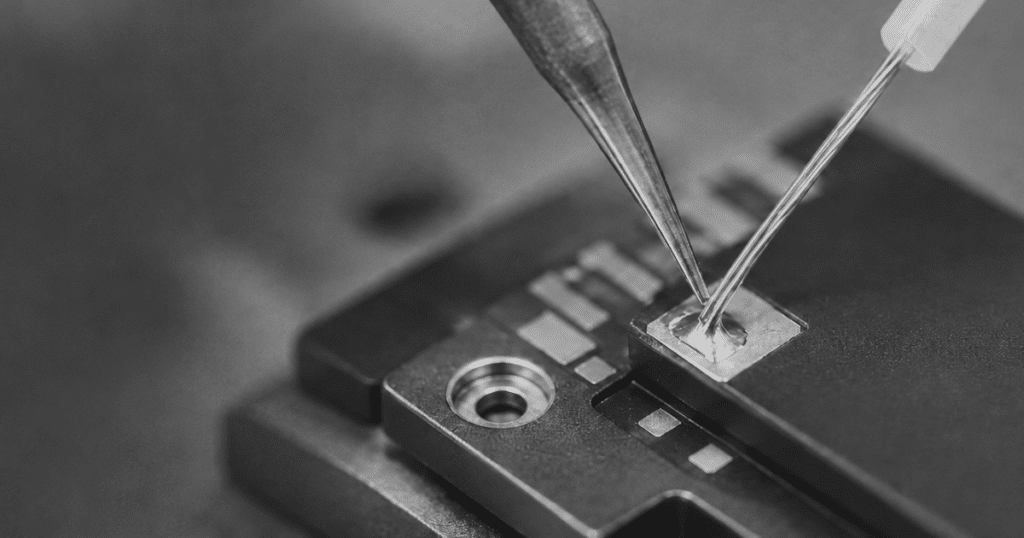
Laser wire stripping removes insulation without ever touching the conductor. The laser energy is tuned to cleanly remove the insulation while leaving the metal underneath unchanged.
Under SEM, the difference is obvious. Laser-stripped conductors appear clean, uniform, and continuous, with no signs of scoring or material loss and no insulation residue left behind.
By taking physical contact out of the process, laser stripping removes one of the biggest sources of variability in wire preparation.
What This Means for Joining and Bond Strength
For joining processes like resistance welding, surface condition matters more than many people expect.
A clean, undamaged conductor provides consistent electrical contact. That leads to predictable heat generation and more uniform weld formation. In practice, this shows up as stronger joints and tighter process windows.
In testing, welds made on laser-stripped wires have shown up to twice the bond strength of those made on mechanically stripped wires. Just as important, the results are more consistent from joint to joint.
All of this is achieved without adding complexity or relying on operator technique to make up for process variation.
Simplifying Process Control
From a quality and regulatory perspective, non-contact stripping makes life easier.
Laser stripping delivers:
-
Repeatable results
-
Minimal operator influence
-
Better consistency from batch to batch
-
Less reliance on subjective visual inspection
By removing mechanical interaction with the conductor, laser stripping takes a hard-to-see variable out of the process and replaces it with something that is easier to control and validate.
Wire stripping plays a much larger role in device reliability than it is often given credit for.
SEM images show that contact-based stripping methods can damage conductors and leave insulation behind, both of which increase the risk of latent failures. Non-contact laser stripping produces a clean, consistent conductor surface that supports stronger, more reliable joints.
For medical device manufacturers focused on reducing risk while maintaining control and throughput, non-contact wire stripping isn’t just an alternative, it’s a smarter way to approach wire preparation.