Laser wire stripping offers precision, consistency, and control but only when the process is right. Here’s why many laser stripping projects fail, and how to avoid it.
Laser wire stripping is often positioned as the solution to challenges in precision wire processing.
Cleaner results. No mechanical damage. Greater control.
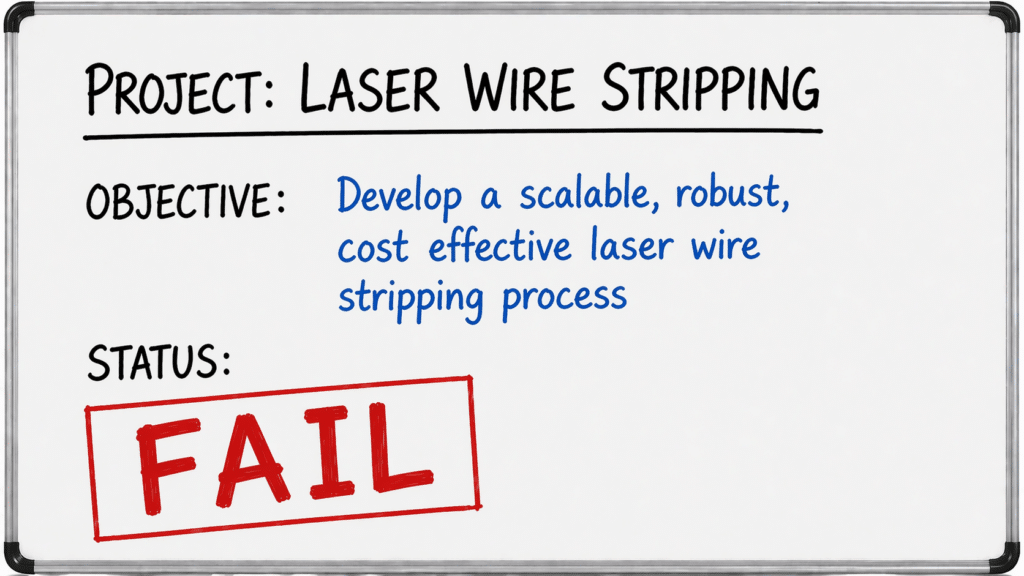
But there’s a gap between what a laser wire stripping system is capable of and what actually happens in production. That gap is where many projects fail.
Not because the laser doesn’t work but because the process behind it hasn’t been fully developed.
At Laser Wire Solutions, we regularly support customers who have experienced this first-hand, struggling to achieve consistent, repeatable results from an existing laser system.
Why Laser Wire Stripping Projects Fail
1. Incorrect or Unstable Laser Parameters
Laser wire stripping relies on precise control of parameters such as:
- laser power
- speed
- frequency
- focal position
Small variations can significantly affect stripping quality.
Without a structured approach, teams often rely on trial-and-error:
- inconsistent strip quality
- conductor damage or residual insulation
- lack of repeatability
How Laser Wire Solutions supports you:
We develop and validate laser stripping parameters using your actual materials ensuring a stable, repeatable process before your system is installed.
2. Operator-Dependent Results in Wire Processing
Many laser wire stripping processes initially depend on skilled operators to achieve the correct result.
This leads to:
- variation between operators
- inconsistent quality over time
- challenges when scaling production
How we solve this:
We define operator-independent processes, with validated settings and clear guidance ensuring consistent results regardless of who is running the system.
3. Poor Understanding of Material Behavior
Different wire types and insulation materials respond differently to laser energy.
Variations in:
- insulation (e.g. PTFE, ETFE, polyimide)
- conductor material
- wire geometry
can completely change the stripping outcome.
Without a deep understanding of material interaction, processes can appear successful in trials but fail in production.
How we approach this:
We work directly with your wire and cable materials to develop a process tailored to your exact application, not a generic setup.
4. Failure to Scale from R&D to Production
A laser wire stripping process that works in R&D does not automatically translate to production.
Scaling introduces challenges such as:
- maintaining consistency at higher volumes
- achieving required cycle times
- ensuring repeatability across shifts
How we support scale-up:
We develop processes with production in mind from the outset, so your system performs reliably under real manufacturing conditions.
The Hidden Cost of Getting Laser Processing Wrong
When laser wire stripping processes are not properly developed, the impact goes beyond quality issues:
- delayed time to production
- increased scrap and rework
- higher engineering resource requirements
- uncertainty in validation and qualification
Lower-cost laser systems can quickly become more expensive when these factors are considered.
A Different Approach to Laser Wire Stripping
At Laser Wire Solutions, we don’t just supply laser wire stripping machines.
We work with customers to deliver a validated, production-ready wire stripping process.
This includes:
- understanding your full application and downstream processes
- developing laser parameters based on real materials
- validating stripping quality for your specific requirements
- building repeatability into the process
- ensuring readiness for production-scale manufacturing
By the time your system is delivered, the process is already defined.
Not “how do we make this work?”
But “how quickly can we run it?”
More Than a Laser Wire Stripping Machine
There are many suppliers of laser wire stripping equipment including lower-cost alternatives.
But access to a machine is not the same as access to a working process.
With Laser Wire Solutions, you gain:
- confidence in process performance
- faster time to production
- consistent, high-quality wire stripping results
- reduced implementation risk
From Uncertainty to Confidence in Wire Processing
A successful laser wire stripping project is not defined by installing a machine.
It’s defined by achieving:
- consistent, repeatable stripping results
- operator-independent performance
- validated process parameters
- confidence at production scale
This is the difference between experimentation and execution.
Conclusion: The Process Is What Makes Laser Wire Stripping Work
A laser is a powerful tool.
But on its own, it doesn’t solve the problem.
The process does.
And getting that process right from the start is what determines whether your laser wire stripping project succeeds.
Talk to Laser Wire Solutions About Your Application
If you’re evaluating laser wire stripping, the most important decision isn’t just the machine, it’s how the process will be developed and proven.