When preparing fine wire for termination, the stripping process is often judged by one immediate question: has the insulation been removed cleanly?
But for applications where the exposed conductor is subsequently joined using ultrasonic welding, that is only part of the picture.
The method used for fine wire stripping can affect the condition of the conductor presented to the next manufacturing process. A recent customer evaluation compared laser wire stripping with manual scraping and then measured the mechanical performance of the resulting ultrasonic welded connections.
The objective was to understand whether moving from a manual stripping process to a controlled laser process could maintain or improve the quality of the final wire-to-wire connection.
The results showed that laser stripping exceeded manual scraping for maximum peel force across three wire configurations evaluated, with particularly significant improvements in one of the applications which were tested.
The challenge: preparing fine wire for ultrasonic welding
The customer’s existing stripping method involved manually removing insulation with a scraper, they had also explored the use of hot tweezers. The operator scraped each side of the wire several times to expose the copper conductor.
Although mechanically straightforward, processes of this kind inherently depend on how the tool is presented to the wire.
For fine wires, this raises questions beyond simply whether all of the insulation has been removed:
- What condition is the underlying conductor left in?
- How repeatable is the preparation process?
- Does the stripping method influence the strength of the subsequent weld?
- Could a more controlled process provide benefits further downstream?
These questions become increasingly important as wire dimensions decrease and the stripped conductor becomes part of a critical electrical or mechanical connection.
Rather than evaluating laser wire stripping vs manual scraping based solely on the appearance of the stripped wire, the customer assessed the performance of the finished ultrasonic welded joint.
Moving from manual scraping to laser wire stripping
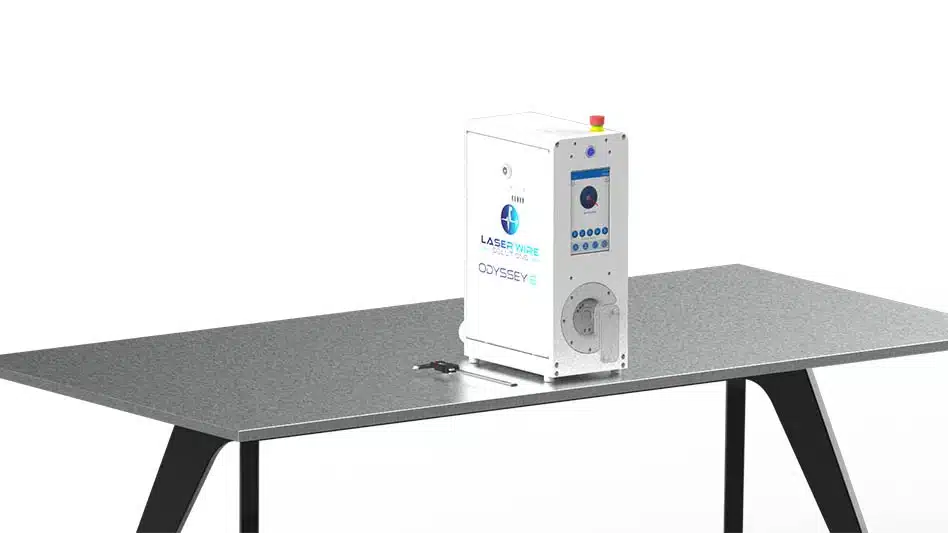
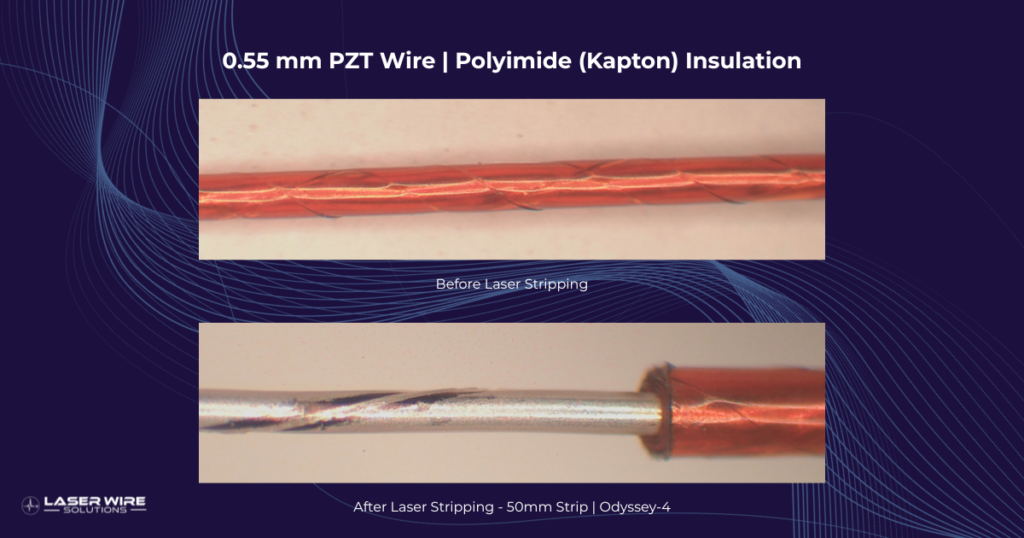
Laser Wire Solutions processed samples using a 355 nm UV laser system.
UV laser processing was selected to remove the insulation while controlling the interaction with the conductor underneath. The process used multiple laser passes to expose the copper surface and was applied consistently across the test samples.
Interestingly, surface roughness alone did not predict the eventual weld result.
The manually scraped samples recorded an average surface roughness of approximately 306 nm Ra, compared with approximately 591 nm Ra for the laser-stripped surface. Despite the manually scraped surface recording the lower roughness value, subsequent mechanical testing showed that this did not translate into better ultrasonic weld strength.
That is an important finding when considering wire preparation for ultrasonic welding.
A surface that appears smoother, or measures as smoother, is not necessarily the surface that will produce the strongest subsequent connection.
How the comparison was tested
Three different wire/joint configurations were evaluated.
For each configuration, the customer compared:
Manual scraping versus laser stripping
The same ultrasonic welding recipe was used for both groups.
Ten samples from each group were then subjected to a 180° peel test.
Two measurements were assessed:
Maximum peel force: the highest force the connection withstands during the test.
Work to failure: the energy absorbed as the connection progresses towards failure, providing additional information about robustness and failure behavior.
This allowed the customer to look beyond whether a weld simply passed or failed and compare how the two wire preparation methods affected the mechanical behavior of the joint.
Laser stripping increased maximum peel force
The clearest difference was seen in maximum peel force.
DM wire configuration
Manual scraping produced a mean maximum peel force of 45.8 N.
Laser stripping increased this to 53.3 N — an improvement of approximately 16%.
LoS wire configuration
The largest difference occurred with the LoS samples.
Manually scraped wires achieved a mean peel force of 44.2 N, while laser-stripped samples achieved 92.1 N.
That represents more than double the average maximum peel force in this test.
RSLoS wire configuration
For the third configuration, performance was essentially equivalent:
- Manual scraping: 34.6 N
- Laser stripping: 35.0 N
Laser processing therefore did not reduce the peel strength of the joint in this configuration.
Across the three tests, there was no wire configuration in which manual scraping produced a higher average maximum peel force than laser stripping.
Results at a glance
| Wire configuration | Manual scraping | Laser stripping | Difference |
|---|---|---|---|
| DM | 45.8 N | 53.3 N | +16% |
| LoS | 44.2 N | 92.1 N | +108% |
| RSLoS | 34.6 N | 35.0 N | Comparable |
What about joint robustness?
Maximum strength was not the only metric considered.
The test also measured the mechanical work absorbed before failure.
For two of the three configurations, the average work value increased after laser stripping:
- DM increased from 56.0 to 64.2 Nmm
- RSLoS increased from 62.2 to 73.4 Nmm
For the LoS configuration, work decreased from 236.2 to 212.9 Nmm, despite the very large increase in maximum peel force.
Importantly, the test did not identify evidence that laser stripping was introducing brittle failure behavior.
That distinction matters. Improving peak strength would be considerably less valuable if the stripping process simultaneously created a more fragile connection.
Instead, the results suggest that laser stripping copper wire can influence the quality of the interface created during subsequent ultrasonic welding without creating evidence of reduced robustness in these tests.
A smoother surface does not necessarily mean a stronger weld
One of the most interesting results from the study is the relationship between surface condition and weld performance.
The manually scraped conductor recorded the lower average surface roughness.
Yet it did not produce the strongest peel-force results.
For manufacturing engineers evaluating enamel wire stripping for ultrasonic welding, this reinforces an important point: wire preparation should not necessarily be optimized around the cosmetic appearance or surface roughness of the stripped conductor in isolation.
The real question is:
How does the preparation method affect the next process?
For ultrasonic welding, that means evaluating the completed joint.
For another application, the relevant downstream measure might instead be solderability, crimp performance, electrical resistance or another process-specific requirement.
What does this mean for fine wire stripping?
Manual scraping can appear to be a simple way of removing insulation, particularly during development or low-volume manufacture.
As products move towards smaller conductors, greater production volumes or tighter process control, however, the stripping stage can become increasingly important.
Laser wire stripping offers the opportunity to replace a physical scraping operation with a controlled, programmed process.
This study indicates that the benefits may extend beyond automation of the stripping operation itself.
In this application, changing the wire preparation method influenced the mechanical performance of the subsequent ultrasonic weld, including an increase from 44.2 N to 92.1 N average peel force for one of the configurations tested.
That is a much more meaningful measure of process performance than simply asking whether the insulation can be removed.
Look beyond the strip
When evaluating a new fine wire stripping process, it is tempting to concentrate on the strip itself.
Is the insulation removed?
Is the conductor visually clean?
Is the strip length correct?
Those are important process requirements, but they do not necessarily tell you whether the wire has been prepared optimally for the next manufacturing step.
This comparison between laser wire stripping and manual scraping demonstrates why downstream testing matters.
For this application, laser-stripped wires exceeded manually scraped samples in average maximum peel strength across all three configurations tested, while one configuration achieved more than twice the average peel force.
For manufacturers using ultrasonic welding on fine wire, evaluating stripping and joining as connected processes rather than independent operations may uncover opportunities to improve the finished connection.
Could your stripping process be affecting what happens next?
At Laser Wire Solutions, we develop laser processes around the application, material and downstream manufacturing requirements, not simply around removing insulation.
If you are currently manually scraping, mechanically stripping or otherwise preparing fine wire before welding, soldering or termination, send us a sample and we can evaluate whether laser processing is suitable for your application.