Fine wire termination is an increasingly important part of medical device, electronics and other precision manufacturing processes.
As devices become smaller and more complex, manufacturers are working with increasingly delicate conductors that must be connected reliably to terminals, contacts, pads, electrodes or other wires.
Fine wire termination can involve several different joining methods, including soldering, crimping and welding. But regardless of the joining technology, one part of the process is sometimes overlooked:
the wire has to be prepared correctly first.
For insulated fine wires, this usually means exposing a precisely controlled area of conductor without damaging the wire and without leaving insulation in the area that needs to be joined.
For very small conductors, achieving that consistently can be just as challenging as making the termination itself.
What is fine wire termination?
Fine wire termination is the process of preparing and connecting a small-diameter electrical conductor to another component or conductor to create a reliable electrical and mechanical connection.
The exact definition of a “fine wire” varies between industries and applications. In medical device manufacturing, for example, fine wire constructions can extend beyond 50 AWG and may include magnet wire, twisted pairs and micro-coaxial cables.
Typical fine wire termination applications include connections to:
- connector pins and contacts
- printed circuit boards and solder pads
- electrodes and sensors
- catheter components
- coils
- other fine wires
- miniature electrical assemblies
Common termination processes include soldering, crimping, resistance or laser welding, and other specialised joining technologies.
However, most of these processes have one fundamental requirement in common:
the conductor needs to be exposed appropriately before the connection can be made.
Fine wire termination starts before soldering or crimping
It is easy to think of the termination process as the moment the solder joint, weld or crimp is made.
In practice, the quality of the connection is influenced by several upstream operations.
For an insulated fine wire, the process may involve:
Insulation removal → conductor preparation → positioning → termination → inspection
If the insulation removal stage is inconsistent, problems can be carried into every step that follows.
For example, a termination process may require a tightly controlled length of exposed conductor. Too little insulation removal may interfere with the joining area, while excessive stripping can expose more conductor than the design requires.
Similarly, physical damage introduced while stripping an ultra-fine conductor may reduce its mechanical integrity even if the finished joint initially appears acceptable.
For this reason, wire preparation should be considered part of the termination process rather than a separate manufacturing operation.
Why is surface condition important in fine wire termination?
Soldering, welding and other joining processes depend on creating a controlled interface between materials.
Insulation is designed to prevent electrical contact, so any remaining coating within the intended termination area can potentially interfere with the joining process.
This becomes particularly significant with enamelled and coated fine wires where the insulation layer may be extremely thin and difficult to inspect visually.
A successful wire preparation process therefore needs to achieve two objectives:
Remove the required insulation.
Preserve the conductor underneath.
The challenge becomes greater as wire diameter decreases.
A process that is perfectly acceptable for a conventional cable may become much harder to control when dealing with the fine wires used in catheters, sensors, miniature electronics and similar precision applications.
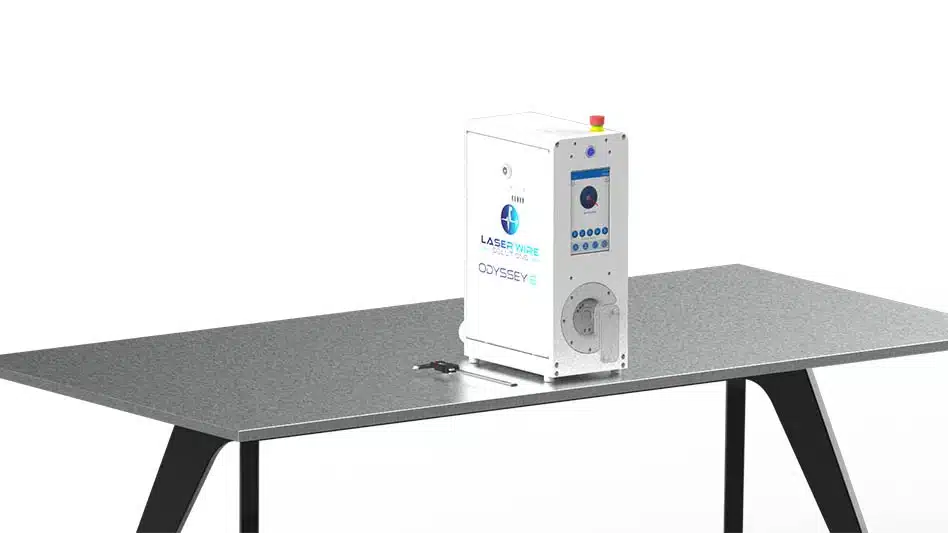
Laser Wire Solutions already processes medical fine wires down to around 50 AWG using its Odyssey range, including single conductors, twisted pairs, bifilar wires and multi-wire applications.
Common methods of preparing fine wire for termination
There are several ways to remove insulation before terminating a fine wire.
Mechanical stripping
Mechanical stripping uses blades or other tooling to cut through and remove the insulation.
It is a well-established process and works extremely effectively for many conventional wires.
As conductors become smaller, however, the available process window also becomes smaller. The tooling needs to remove the insulation without cutting, scraping or deforming the conductor beneath it.
Tool condition, alignment and setup can therefore become increasingly important.
Abrasive stripping
Abrasive wheels or brushes can be used to physically remove coatings such as enamel.
Again, this can be an effective process for suitable wires, but the wire and stripping media are physically interacting.
For delicate conductors, manufacturers therefore need to understand what effect the process has on the underlying material.
Thermal stripping
Heat can be used to soften or remove certain insulation materials.
Its suitability depends heavily on the coating involved and the requirements of the subsequent termination process.
Manufacturers may also need to evaluate any material remaining on the conductor after the thermal process.
Chemical stripping
Chemical stripping has traditionally been used for some difficult-to-remove coatings and fine wire applications.
It avoids the direct contact associated with mechanical stripping, but brings different considerations around chemical control, handling, waste and the repeatability of the stripped geometry.
Laser wire stripping
Laser wire stripping removes insulation using controlled laser energy rather than a cutting tool.
Because the process is non-contact, there is no blade pressing against the conductor.
The laser process can instead be developed around the combination of insulation, conductor material and required strip geometry.
For precision fine wire applications, this makes it possible to create a controlled strip area ready for the subsequent termination operation.
Laser Wire Solutions uses different laser technologies depending on the material being processed, with systems capable of processing fine enamel wires as well as polymer-insulated conductors and more complex cable constructions.
Why use laser stripping before fine wire termination?
The important benefit of laser stripping in this application isn’t simply that a laser can remove insulation.
It is the ability to develop the stripping process around the termination requirement.
Non-contact processing
There is no mechanical blade contacting the conductor during the stripping process.
For fine and ultra-fine wires, this removes one potential source of nicking, scraping and physical deformation.
Controlled strip length
The exposed conductor can be positioned according to the requirements of the subsequent joining process.
That becomes important when only a very small termination area is available.
Repeatable processing
Once the application has been developed, the laser parameters and processing pattern can form part of a repeatable recipe.
This is especially valuable where production is moving away from highly operator-dependent processes.
Complex geometries
Laser processing does not necessarily have to create a conventional straight strip around the end of a wire.
Depending on the application and equipment, specific processing patterns, windows or partial strips can be developed.
Preparation for automation
When stripping and termination are treated as parts of the same manufacturing process, there is greater opportunity to consider how operations such as loading, stripping, positioning, joining and inspection could eventually be integrated.
Fine wire stripping and micro-soldering
Removing the insulation is only half of the challenge.
The prepared conductor still needs to be connected.
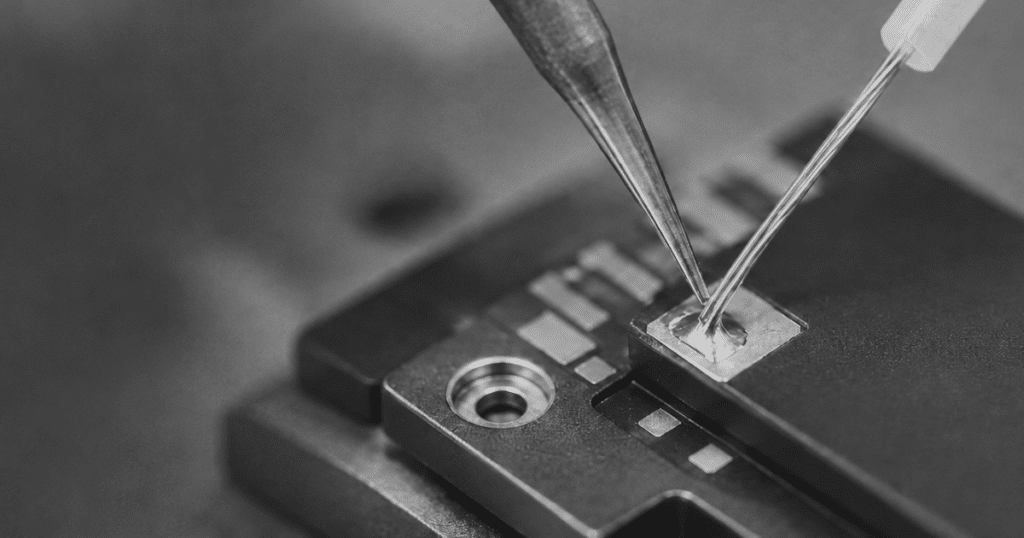
Micro-soldering is one termination method used where very small conductors need to be joined to terminals, pads or other components within restricted spaces.
At this scale, the relationship between wire preparation and soldering becomes particularly important.
The objective isn’t simply to perform two independent operations:
strip the wire
and then
solder the wire.
Instead, the entire process should be developed around the final connection.
Questions include:
- How much conductor needs to be exposed?
- Where should the strip begin and end?
- Does the termination require the conductor to be tinned?
- How will the wire be positioned during soldering?
- What temperature and solder delivery are required?
- How will repeatability be controlled?
- How will the completed joint be inspected?
- Could stripping and soldering ultimately be automated as a combined process?
Laser Wire Solutions has been developing micro-soldering applications alongside precision laser wire preparation, allowing the stripping and joining requirements to be considered together rather than as isolated processes.
This reflects a broader capability at LWS: our wire-processing experience extends beyond insulation removal into cutting, stripping and soldering applications.
Why fine wire termination is particularly challenging in medical devices
Fine electrical conductors are used throughout modern medical technology, including interventional cardiology devices, surgical instruments, ultrasound equipment and other miniature cable assemblies.
Applications can include:
- electrophysiology and mapping catheters
- IVUS and ICE catheters
- diagnostic guidewires
- neurological devices
- cochlear implants
- miniature sensors
- ultrasound assemblies
- endoscopic systems
These devices may contain multiple extremely small conductors within very limited available space.
As more functionality is incorporated into smaller devices, the number and density of these electrical connections can increase.
This creates a manufacturing challenge:
How do you repeatedly prepare, position and terminate increasingly small wires without introducing unnecessary variation?
There is rarely a single answer.
Instead, the entire fine wire process needs to be developed around the component.
From manual termination to a controlled manufacturing process
Many fine wire applications begin at relatively low production volumes.
A skilled operator may strip a wire, position it manually and create a soldered or welded termination under magnification.
That approach can be entirely appropriate during development.
The manufacturing challenge often emerges later.
If the device progresses from development into higher-volume production, manufacturers may need to achieve the same result hundreds or thousands of times.
At that stage, questions around process variation become increasingly important.
Rather than asking:
“How do we automate our existing manual operation?”
it can be more useful to ask:
“How should this termination process be designed for repeatable production?”
That may result in changes to the wire preparation process, fixturing, strip geometry, soldering method, inspection or the sequence in which each operation takes place.
Developing a fine wire termination process
For particularly challenging applications, the answer may not be an off-the-shelf machine.
Process development should begin with the actual component and the connection that needs to be created.
At Laser Wire Solutions, our applications team can evaluate factors including:
Wire construction
Solid, stranded, bifilar, multifilar, magnet wire or micro-coax.
Conductor material
Including the interaction between the conductor and the selected laser wavelength.
Insulation
Its material, thickness and behaviour during laser processing.
Strip geometry
The amount and position of conductor that needs to be exposed.
Termination method
Whether the subsequent operation involves soldering, welding, crimping or another joining process.
Production requirements
Including cycle time, loading, inspection, traceability and future automation.
Considering all of these factors together helps avoid optimising the wire stripping process in isolation while creating difficulties further downstream.
A good termination starts with a good strip
Fine wire termination is ultimately about creating a reliable connection.
But that connection cannot be considered independently from the way the conductor has been prepared.
For increasingly small and delicate wires, clean, accurately positioned and repeatable insulation removal can be fundamental to the success of the subsequent soldering, welding or crimping operation.
Laser wire stripping provides manufacturers with another way to control this critical preparation stage while avoiding physical contact between stripping tooling and the conductor.
And as applications progress towards greater automation, there is an opportunity to go further — treating stripping, positioning and micro-soldering as elements of one engineered manufacturing process rather than separate operations.
Working on a fine wire termination challenge?
Whether your challenge involves fine wire stripping, micro-soldering or developing a complete wire preparation and termination process, our applications team can evaluate the component and help determine the most appropriate approach.
Talk to Laser Wire Solutions about your application.