Chemical wire stripping has been used for decades to remove enamel, polymer and other insulation materials from electrical conductors, particularly where conventional blades or mechanical stripping methods are difficult to use.
For fine wires, magnet wire and delicate conductors, the attraction is understandable. Chemical stripping removes insulation without a cutting blade coming into direct contact with the conductor.
However, changing regulations, chemical handling requirements and increasingly demanding manufacturing processes are causing manufacturers to reconsider how insulation removal fits into modern production.
In the US, this has become particularly relevant following the EPA’s regulation of methylene chloride. The EPA’s final rule prohibits most industrial and commercial uses of methylene chloride, while allowing certain specified uses to continue under workplace protection requirements.
For manufacturers reviewing an existing chemical wire stripping process, the question is therefore becoming less about finding a direct replacement for a particular chemical and more about asking:
If we were developing this manufacturing process today, how would we remove the insulation?
What is chemical wire stripping?
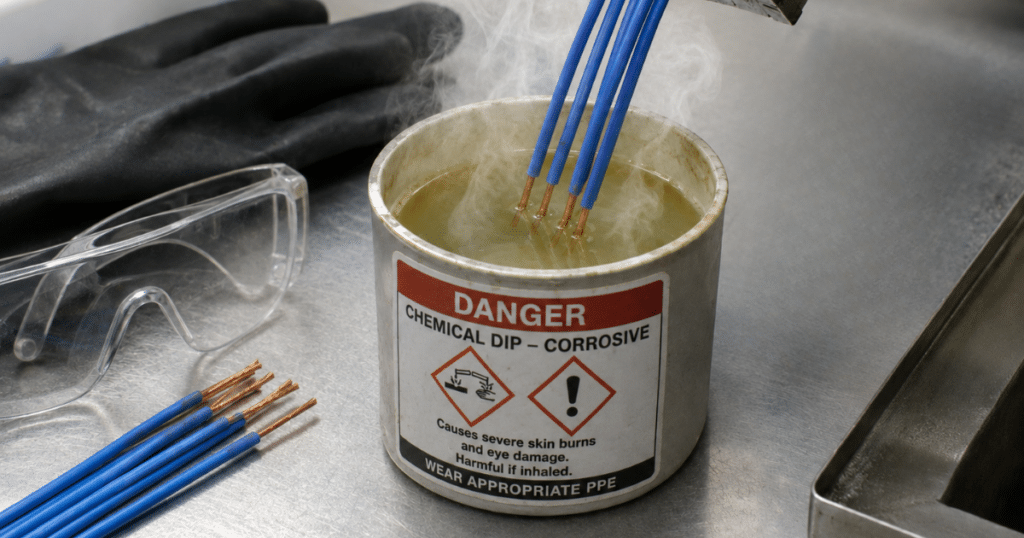
Chemical wire stripping uses a chemical agent to dissolve, soften or break down the insulation surrounding a wire or conductor.
Depending on the insulation material and process, this can involve solvent-based products, chemical stripping agents or other specialist formulations.
Unlike mechanical stripping, there is no blade cutting through the insulation. This has historically made chemical stripping useful for applications involving delicate conductors or coatings that are difficult to remove mechanically.
For occasional processing or established applications, a chemical method may continue to be appropriate where its use is permitted and the necessary controls are in place.
The challenge comes when the process needs to become more controlled, repeatable and scalable.
Why are manufacturers reconsidering chemical wire stripping?
Removing insulation is often treated as a relatively small step in the manufacturing process, but its impact can extend much further downstream.
The quality of a stripped conductor can affect subsequent processes including soldering, welding, crimping, electrical testing and assembly.
As manufacturers increase production volumes or introduce greater process control, several characteristics of chemical stripping deserve consideration.
Chemical handling and waste
Chemical processes may require controlled storage, operator protection, rinsing, neutralisation and disposal procedures.
These requirements become part of the manufacturing process even though they do not directly contribute to the finished component.
Changes to the availability or permitted use of particular chemicals can also force manufacturers to reassess processes that may have been established for many years.
Process localisation
Chemical stripping typically relies on exposing a defined area of the wire to the stripping medium.
For applications requiring tightly controlled strip lengths or specific insulation removal geometries, precisely controlling where the chemical acts can become challenging.
This becomes increasingly important where a stripped area must align with a later welding, soldering or assembly operation.
Operator dependency
Manual loading, immersion time, cleaning and inspection can all introduce variables into a chemical stripping process.
For low-volume production this may be manageable. At higher volumes, however, manufacturers increasingly look for processes that can be defined by controlled parameters rather than operator technique.
Integration into automated production
Manufacturing automation increasingly requires individual processes to communicate with, and fit within, the wider production cell.
Processes based on manual chemical handling can be more difficult to integrate into this type of manufacturing environment.
This is one reason insulation removal is increasingly being considered as part of the overall production strategy rather than as an isolated operation.
What are the alternatives to chemical wire stripping?
There is no single stripping method that is right for every wire.
The appropriate technology depends on factors including the conductor material, insulation, wire diameter, strip geometry, production volume and downstream process.
Mechanical stripping
Mechanical stripping uses blades or cutting tools to remove insulation.
It is an established and effective method for many conventional wires and cables and can provide fast cycle times.
However, because the tooling physically interacts with the wire, tool setup and wear need to be controlled. On very small or delicate conductors, contact with the conductor can also create a risk of marking, deformation or nicking.
Abrasive stripping
Abrasive wheels, brushes and similar methods physically remove the insulation from the conductor.
These processes can work effectively with certain coatings, particularly where removal does not require extremely tightly controlled geometry.
As with mechanical methods, however, the process involves physical interaction with the conductor and can be influenced by tooling condition and process setup.
Thermal stripping
Thermal methods use heat to soften, melt or burn away insulation.
The technique is relatively straightforward, but the suitability depends heavily on the insulation and conductor involved.
Some enamelled materials can char during thermal processing, potentially creating residue that then needs to be removed before the conductor proceeds to soldering, welding or another joining process.
Chemical stripping
Chemical stripping remains an option for applications where an appropriate chemical process is available and can be safely and consistently controlled.
Its advantages include the absence of mechanical cutting forces.
However, manufacturers also need to consider chemical management, process localisation, cleaning, waste and the ability to integrate the process into future production.
Laser stripping
Laser stripping uses controlled laser energy to remove the insulation without a blade physically contacting the conductor.
Rather than relying on a cutting edge or chemical reaction, processing parameters can be developed around a specific combination of conductor and insulation.
For suitable applications, this creates a repeatable, recipe-controlled method of removing insulation.
Laser stripping is already used across fine wire, medical wire and magnet wire applications. Laser Wire Solutions’ systems, for example, include processes for fine enamel wires as small as 50 AWG as well as significantly larger magnet wire applications.
Why is laser wire stripping different?
The key difference isn’t simply that laser stripping removes the chemical.
It changes how the stripping process is controlled.
Once a laser process has been developed, parameters such as processing position, laser energy, pattern and strip geometry can form part of a defined recipe.
Instead of an operator determining whether enough material has been removed manually, the goal is to create a process capable of producing the same result repeatedly.
For manufacturers working within controlled or validated production environments, that distinction can be important.
It can also support a future move towards automation because the stripping operation can be incorporated into a wider machine or production sequence.
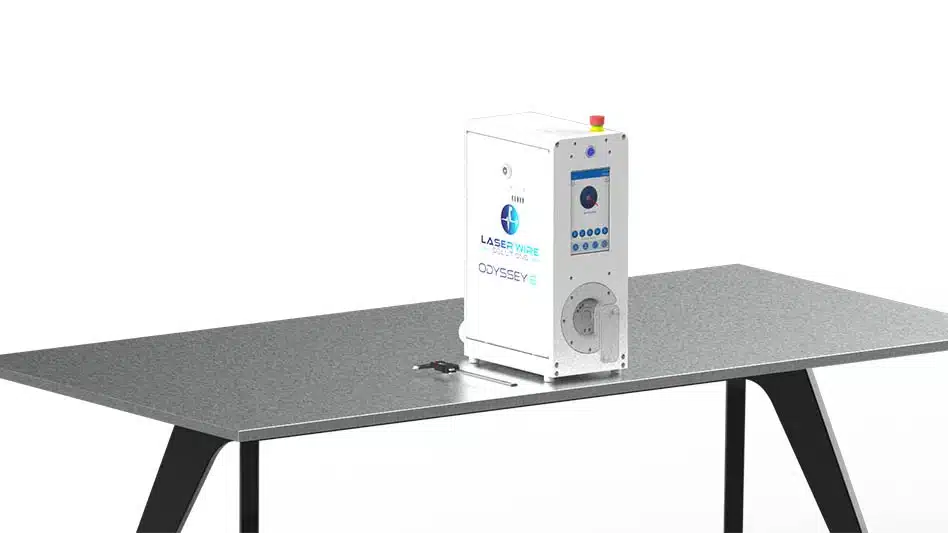
For magnet wire applications, for example, Laser Wire Solutions uses controlled laser ablation to remove enamel without physical contact with the conductor. Round conductors can also be processed around the circumference to prepare a defined area for subsequent soldering, crimping or welding.
When does laser stripping make the most sense?
Laser processing becomes particularly interesting when the difficulty of the application starts to expose the limitations of more conventional stripping methods.
Fine and ultra-fine wires
As conductors become smaller, the margin between removing the insulation and damaging the conductor becomes increasingly narrow.
Non-contact processing removes the requirement for a blade to be positioned mechanically against the wire.
This is particularly relevant within medical devices, sensors, microelectronics and other applications involving very small conductors.
Magnet and enamel wire
Magnet wire insulation is designed to adhere strongly to the conductor, which can make it challenging to remove consistently.
Chemical, abrasive and thermal processes are all used within the industry, but laser ablation provides another approach where the stripping geometry can be developed around the specific wire.
Laser Wire Solutions has demonstrated laser processes on both round and rectangular magnet wires, including samples subsequently evaluated for soldering.
High-value conductors
Where the wire itself is expensive, reducing the likelihood of conductor damage and associated scrap becomes increasingly important.
This can include specialist medical wires, aerospace conductors and other high-value electrical assemblies.
Applications moving towards automation
A process that works successfully at a laboratory bench is not automatically the right process for production.
If volumes are expected to increase, manufacturers should consider how insulation removal will eventually fit into the wider manufacturing sequence.
A repeatable laser process can be incorporated into standalone equipment, semi-automated systems or more highly automated production environments.
Is laser stripping completely process-free?
No.
Replacing chemical stripping with laser processing does not remove the need for process control.
A laser process must first be developed around the particular insulation and conductor combination. The correct laser technology and processing parameters need to be selected, and the result should be evaluated against the requirements of the downstream application.
Laser processing also produces fumes and particulates from the ablated insulation, so suitable extraction is required. Laser Wire Solutions’ precision stripping platforms, for example, specify extraction as part of the installation requirements.
This is why selecting a laser based purely on power or wavelength is rarely the best approach.
The application comes first.
Replacing chemical stripping is more than an equipment substitution
When an established chemical process needs to change, it can be tempting to search for a piece of equipment that reproduces exactly the same operation.
There may be a better opportunity.
Changing the insulation removal method provides manufacturers with a chance to look at the complete process:
How is the wire loaded?
How accurately does the strip need to be positioned?
What happens to the conductor immediately afterwards?
How is strip quality verified?
Could several processing steps eventually be combined?
What production volume will be required in three or five years?
These questions can lead to a very different solution from simply replacing one stripping station with another.
At Laser Wire Solutions, this is why we take an application-first approach to laser processing. The objective is not simply to supply a laser system, but to develop the process required around the wire, component and manufacturing requirement.
Considering an alternative to chemical wire stripping?
If you currently use chemical stripping, mechanical stripping, thermal stripping or another insulation removal method and are evaluating alternatives, the first step should be to understand whether laser processing is technically suitable for your specific wire.
Material, insulation thickness, conductor construction, strip geometry and downstream requirements can all influence the process.
Rather than assuming laser stripping is the answer, we can evaluate the application and determine whether a suitable laser process can be developed.
Have a wire stripping application you’d like us to evaluate? Talk to our team to discuss your current process and the result you need to achieve.