How UV laser stripping provides clean, repeatable insulation removal from copper, niobium-titanium and phosphor bronze cryogenic wiring
Preparing fine cryogenic wire for termination presents an unusually difficult manufacturing challenge.
The insulation must be removed completely to achieve a reliable solder, crimp or bond connection. At the same time, the underlying conductor may be only a fraction of a millimetre in diameter and cannot tolerate mechanical damage, chemical attack or uncontrolled heat exposure.
For many cryogenic wiring applications, this has left manufacturers relying on manual scraping or chemical stripping processes that are difficult to control, hazardous to operate and heavily dependent on operator skill.
Testing completed by Laser Wire Solutions demonstrates an alternative. Using the Odyssey 4 UV laser system, HML polyimide and Formvar insulation was successfully removed from copper, niobium-titanium and phosphor bronze twisted-pair cables with no chemical treatment and no mechanical contact with the conductor.
Across the samples evaluated, the process produced a controlled 2 mm circumferential strip. The exposed conductors passed solder-dip wetting and scanning electron microscope inspection, with no residue or visible conductor damage.
Why cryogenic wiring is difficult to process
Cryogenic wiring carries electrical signals or power from room temperature into progressively colder areas of a cryostat, dilution refrigerator or other low-temperature system.
The wiring must provide the required electrical performance while limiting the amount of heat conducted into the cold stages. This requirement leads engineers to use extremely fine conductors and specialised materials selected for their electrical and thermal behaviour.
Common conductor materials include:
Copper
Copper provides high electrical conductivity and is commonly used for power feeds, higher-current connections and warmer sections of a cryogenic assembly.
However, fine copper conductors are soft and easily nicked. Even minor mechanical damage can create a stress concentration that develops into a fatigue failure during repeated thermal cycling.
Niobium-titanium
Niobium-titanium is used for superconducting connections on the coldest stages of a system. These conductors may contain fine superconducting filaments within a copper-nickel or copper matrix.
Mechanical scraping can damage these filaments without producing an obvious visual defect. The effect may only become apparent when the assembly reaches its operating temperature and fails to achieve the expected critical current.
Phosphor bronze
Phosphor bronze offers lower thermal conductivity than copper while maintaining adequate electrical conductivity. It is therefore widely used for thermometry, sensor and low-level signal connections where reducing heat leak is a priority.
The material is harder and springier than copper, making it particularly difficult to strip consistently with a blade or abrasive tool.
The insulation creates an additional challenge
Cryogenic twisted-pair wires may have an overall diameter of approximately 0.1 to 0.25 mm, with the insulation itself measured in only a few microns.
Two frequently used insulation systems are:
HML polyimide, NEMA MW 16: A highly resistant aromatic polyimide enamel selected for its thermal, chemical and mechanical durability.
Formvar, NEMA MW 15: A polyvinyl formal insulation with strong adhesion and good abrasion resistance.
These properties make both materials suitable for demanding cryogenic environments. They also make the insulation extremely difficult to remove without affecting the underlying conductor.
The manufacturing process must therefore remove a very thin, highly resistant polymer coating to a defined length, potentially across multiple wires in a twisted bundle, without cutting, deforming or contaminating the metal beneath it.
Limitations of chemical stripping
Chemical stripping is used because it can attack resistant enamel systems without requiring mechanical force. However, the process introduces several quality, safety and repeatability concerns.
The process cannot be precisely contained
A chemical solution attacks every surface it reaches. It cannot create a sharply defined boundary between stripped and unstripped insulation.
In twisted pairs and multi-wire bundles, the liquid can also travel between the wires through capillary action. This may extend the chemically affected area beyond the intended strip length and into sections of the cable that are difficult to rinse effectively.
Residues can remain within the bundle
Cryogenic assemblies may operate under vacuum and experience significant temperature changes. Chemistry or rinse residue trapped between wires can contribute to corrosion, contamination or outgassing after the assembly has been installed.
These issues may not become visible during room-temperature inspection and can instead develop after repeated thermal cycling.
Process conditions change over time
Chemical strip performance depends on bath concentration, temperature and dwell time. As the bath ages, operators may compensate by changing immersion times or judging completion visually.
This makes it difficult to maintain a stable and repeatable process from one batch, shift or operator to another.
The compliance burden is significant
Although the stripping chemical itself may appear inexpensive, the surrounding process may require:
- COSHH assessments and control measures
- Fume extraction and spill containment
- Specialist personal protective equipment
- Chemical storage and stock management
- Operator training and exposure monitoring
- Neutralisation and licensed hazardous-waste disposal
These controls increase the true cost and complexity of maintaining the process.
Limitations of mechanical stripping
Mechanical alternatives include scalpels, abrasive paper, wire brushes, glass-fibre tools and purpose-designed scraping equipment.
With resistant enamels such as HML polyimide and Formvar, the operator must apply enough force to break through a strongly bonded coating while working on a conductor that may be approximately one-tenth of a millimetre in diameter.
The resulting quality depends on operator technique, eyesight, fatigue, tool condition and available processing time.
Common risks include:
- Variable strip lengths between adjacent wires
- Nicks, scores, flats or reduced conductor cross-sections
- Residual insulation on the underside of the wire
- Ragged or inconsistent insulation boundaries
- Damage to NbTi filaments that cannot be identified visually
- High labour requirements as termination volumes increase
These are not simply cosmetic defects. Residual insulation can prevent complete solder wetting, while a conductor nick can become a failure point during thermal contraction.
How UV laser wire stripping works
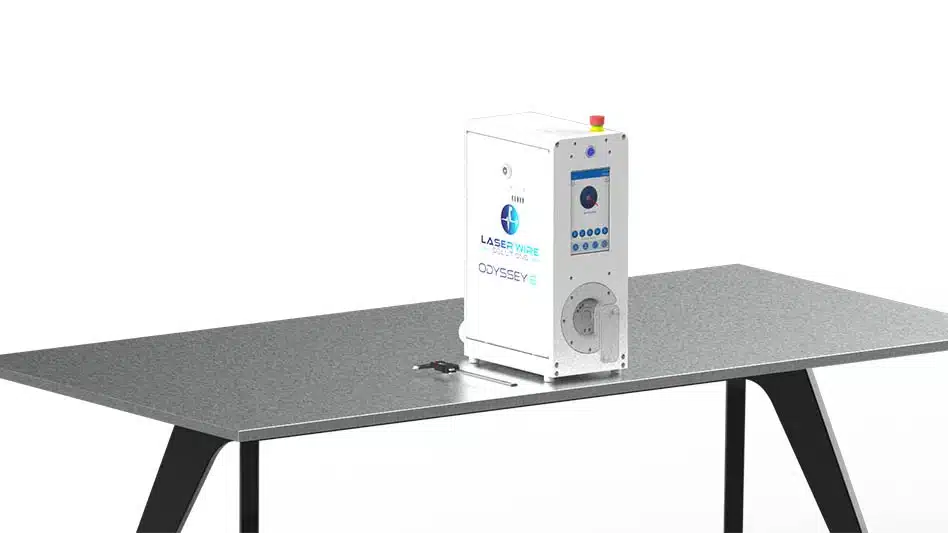
The Odyssey 4 Series uses a 355 nm ultraviolet laser to remove polyimide-type insulation through controlled laser ablation.
At this wavelength, the polymer coating absorbs the laser energy efficiently. The enamel is removed from the defined processing area without a blade, abrasive tool or chemical bath contacting the conductor.
A focused laser spot of approximately 15–20 microns is scanned across the programmed strip area. The position, pattern, laser energy, number of passes and other processing parameters are stored within the machine recipe.
This provides three important advantages for cryogenic wire preparation.
A defined strip length
The exposed conductor length is set as a programmed dimension rather than being judged manually. This creates a clear boundary between the processed and unprocessed insulation.
Non-contact processing
No blade or scraping tool touches the conductor. This avoids the nicks, flattened sections and abrasion associated with mechanical methods.
No liquid chemistry
The insulation is ablated and removed through the system’s extraction unit. There is no chemical bath to wick along the twisted bundle and no stripping solution that must subsequently be rinsed from the wire.
The Odyssey 4 Series uses optical scanners above and below the wire, allowing the insulation to be removed from both sides during the same operation. On appropriately sized fine wires, the two processed areas meet to provide complete circumferential coverage.
Results from cryogenic wire trials
Laser Wire Solutions evaluated multiple twisted-pair cryogenic cables using a 4 W Odyssey 4 UV laser system.
The submitted samples included:
- Copper conductors
- Niobium-titanium conductors
- Phosphor bronze conductors
- HML polyimide insulation
- Formvar insulation
- Cable diameters between approximately 0.1 and 0.25 mm
- A target circumferential strip length of 2 mm
The processed samples were assessed using optical microscopy, a solder-dip wetting test and SEM surface inspection.
All three conductor types were stripped successfully.
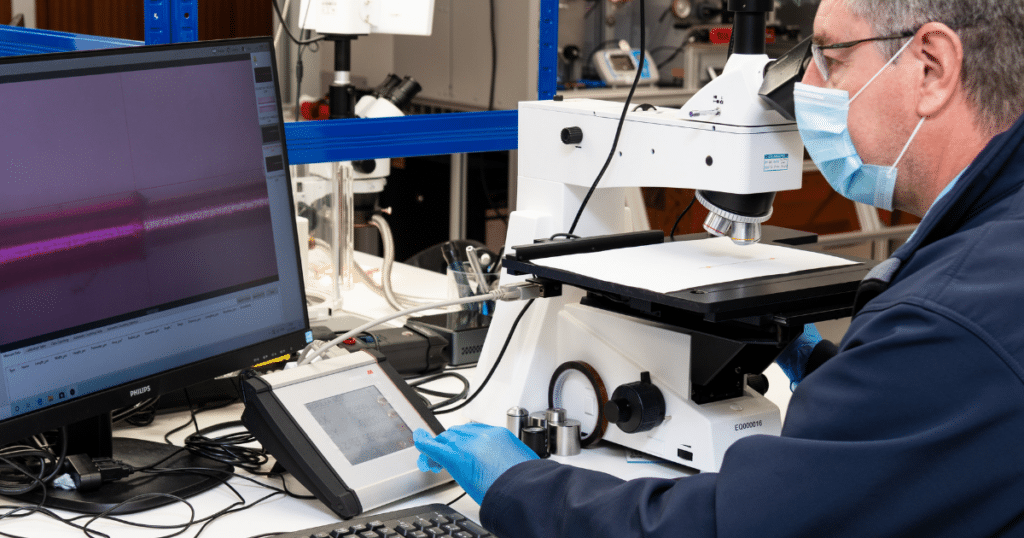
Microscope inspection showed a consistent 2 mm exposed length across the wires within the processed bundles. The insulation remained intact immediately outside the programmed strip area, while the exposed conductors showed no visible residue, discolouration or mechanical damage.
The solder-dip test produced complete and even wetting, confirming that the exposed surfaces were suitable for soldering without an additional post-strip cleaning stage.
SEM inspection also showed clean conductor surfaces with the original profiles intact and no visible melting, pitting or mechanical damage.
Processing time was approximately 60 seconds per cable-end group. This represented a fixture load containing multiple wire ends rather than 60 seconds for each individual conductor.
Results relate to the specific samples submitted for evaluation. Each conductor, insulation build and harness configuration should be tested using representative production material before the process is introduced.
Comparing the stripping methods
| Requirement | Chemical stripping | Mechanical stripping | UV laser stripping |
|---|---|---|---|
| Defined strip length | Difficult to contain; chemistry may wick into the bundle | Dependent on operator judgement | Programmed processing dimension |
| Contact with conductor | Chemical exposure | Direct mechanical contact | Non-contact |
| Circumferential coverage | Difficult to control | Frequently incomplete | Dual-sided laser processing |
| Contamination risk | Chemical and rinse residues | Abrasive debris | No liquid chemistry |
| Repeatability | Changes with bath condition and dwell time | Changes with operator and tool condition | Stored, recipe-controlled parameters |
| Operator dependency | Manual handling and timing | High level of manual skill required | Operator loads the fixture and selects a recipe |
| Scalability | Limited by bath management and inspection | Increases directly with operator hours | Determined by fixture capacity and cycle time |
| Process auditability | Difficult to demonstrate consistent control | Limited formal process control | Stored recipes, access control and diagnostics |
Integrating laser stripping into production
A successful cryogenic wire stripping process depends on more than the laser alone. Fixturing is particularly important.
The wires must be held at a consistent height, position and tension so the programmed laser pattern aligns with the intended processing area. For multi-wire harnesses, the fixture can also allow several ends to be processed within the same cycle.
A typical production process consists of:
- Loading and tensioning the wire or harness in the fixture
- Selecting the validated recipe
- Processing the insulation from both sides
- Optionally trimming the conductors to final length
- Unloading and inspecting the completed ends
Laser Wire Solutions develops the process using representative customer samples. This establishes the correct laser parameters, achievable strip length, fixture arrangement and expected cycle time.
Verification can include optical inspection, solder-dip testing, SEM inspection and mechanical testing where appropriate. The results are then documented in an LWS Sample Report to support the customer’s internal qualification and validation activities.
A more controllable approach to cryogenic wire preparation
For manufacturers of cryostat looms, dilution refrigerator wiring, superconducting magnet connections, thermometry harnesses and low-temperature detector systems, wire preparation can be one of the least controlled stages of the assembly process.
UV laser stripping replaces manual scraping or chemical immersion with a defined, non-contact and recipe-controlled operation.
Testing on copper, niobium-titanium and phosphor bronze twisted pairs demonstrates that HML polyimide and Formvar insulation can be removed to a consistent 2 mm length while producing clean, solderable conductor surfaces.
By validating the process against the actual wire and harness construction, manufacturers can reduce operator dependency, improve strip-length consistency and remove hazardous chemical stripping activities from the production environment.
Evaluate your cryogenic wire application
Laser Wire Solutions can process representative samples of your cryogenic wire, develop the stripping parameters and provide a written Sample Report containing process images and results against your acceptance criteria.
Send details of your conductor material, insulation type, wire diameter, required strip length and termination method to sales@laserwiresolutions.com.