Medical device micro-assembly brings small components together to create a functional subassembly. Depending on the design, this can involve positioning fine wires, locating miniature electrodes, inserting components into tubing, or joining electrical connections. A repeatable assembly process depends on the condition, geometry, and presentation of the components entering it.
For manufacturers developing catheter, sensor, and other miniature device assemblies, component preparation deserves attention early in development. A wire that is difficult to position, an inconsistent exposed length, or a poorly defined joining surface can create problems that become harder to resolve after assembly.
What makes medical micro-assembly challenging?
Small components leave limited room for handling and positioning. Features may be difficult to see, flexible parts can move during loading, and the joining area may become inaccessible as the assembly develops.
The challenge is therefore broader than making each component to its drawing. Engineers also need to establish how parts will be presented, located, held, joined, and inspected.
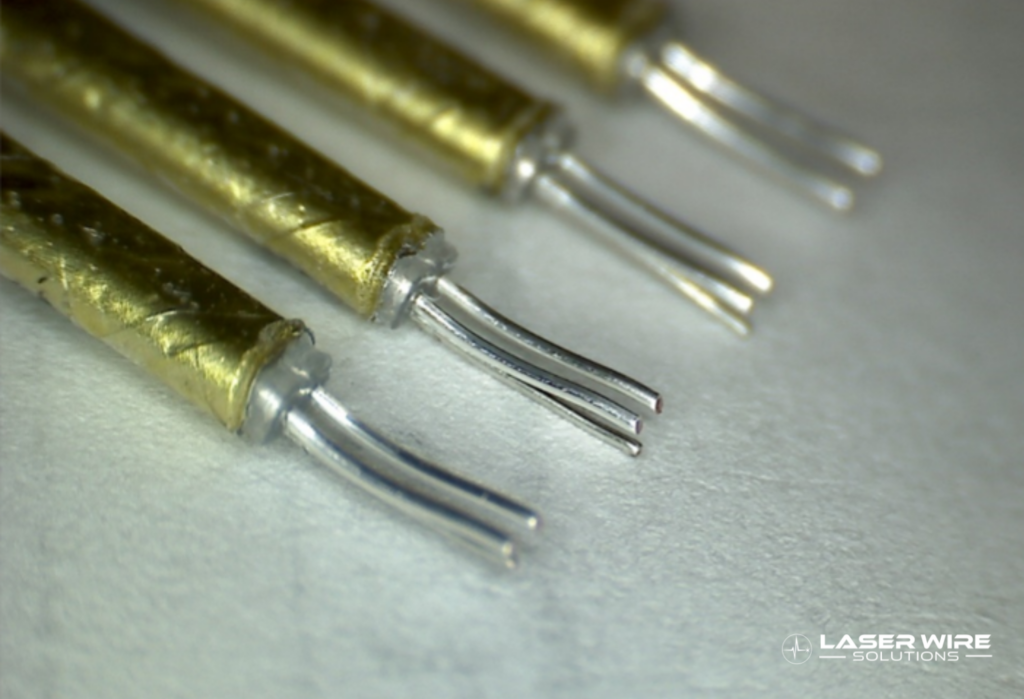
Consider a fine insulated wire being positioned against a miniature contact. The exposed conductor needs to reach the intended joining area while the retained insulation remains appropriately located. Both the component geometry and its presentation influence whether this can be achieved consistently.
This is why component preparation and assembly development should be considered together.
Define the assembly interface first
Before selecting a stripping or cutting process, identify what the next operation needs from the component.
Useful questions include:
- Which surfaces must make contact?
- Where must insulation remain?
- What feature establishes the component’s position?
- How will the part be held during joining?
- Which features become inaccessible afterward?
Translate the answers into component requirements and assembly instructions. Avoid expecting the operator to compensate for poorly defined geometry through manual adjustment.
A clearly defined interface also helps suppliers understand which features are functionally important. A dimension that appears minor on an isolated wire may determine whether it can be positioned correctly in the assembly.
How does wire preparation affect micro-assembly?
Exposed conductor length
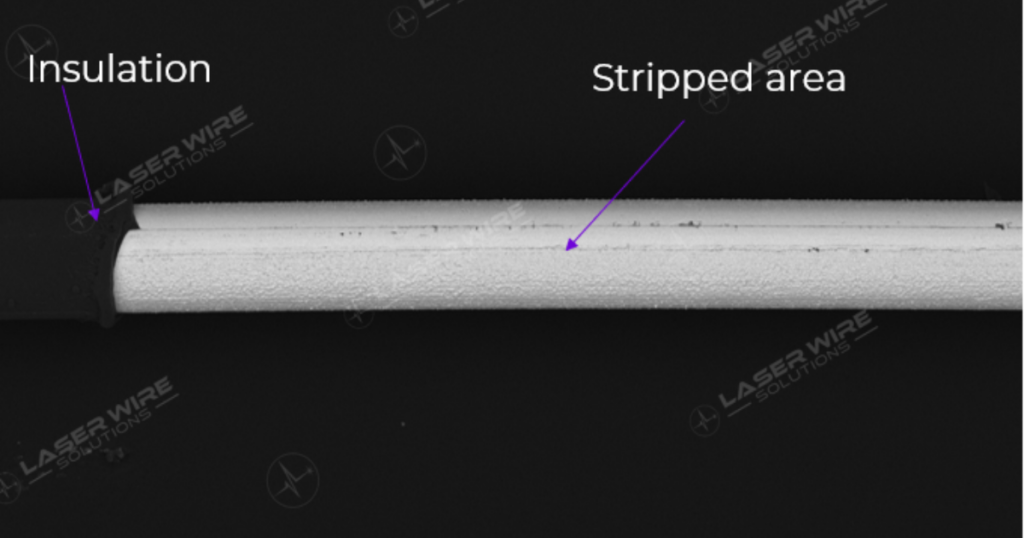
The stripped region must suit the intended connection. Excess exposure can create an unwanted uninsulated section, while insufficient exposure may leave insulation within the joining area.
Specify the required length and its location relative to an agreed datum. For a window strip, define both the window length and its position.
The appropriate dimensions depend on the device and joining method. They should come from the assembly requirements rather than a generic stripping recommendation.
Conductor condition
Notching, deformation, broken strands, or changes to a required surface layer may affect the subsequent operation.
Define the relevant acceptance criteria and how they will be inspected. Avoid relying solely on whether the prepared wire looks clean to the unaided eye.
Where a plated conductor is used, establish whether the plating contributes to the joining process and how its condition will be assessed.
Insulation boundaries
The retained insulation is part of the assembly geometry. Its edge position and condition can influence insertion, positioning, and electrical separation.
Assess the area adjacent to the processed feature as well as the exposed conductor itself. A satisfactory strip length does not establish that all nearby material remains suitable.
Match preparation to the joining method
Micro-assembly may involve welding, soldering, bonding, or mechanical attachment. Each method creates its own requirements for the prepared components.
For example, the exposed area, contact geometry, and access needed for welding may differ from those needed for soldering. Joining technology should be selected for the actual materials and construction; micro-joining equipment suppliers offer different technologies for different applications.
The practical implication is to evaluate preparation using the intended downstream process.
A successful insulation-removal trial establishes useful evidence, but it does not automatically establish joint performance. Where appropriate, prepare representative components, assemble them using the proposed method, and assess the resulting connection against approved requirements.
Handling and fixturing are part of the process
A component can meet its dimensional requirements and still be difficult to assemble consistently.
Fine wires may bend during transfer. Small parts may rotate during loading. A fixture may locate one feature accurately while leaving another insufficiently supported.
During development, assess:
- How the component is picked up and loaded.
- Which feature establishes its position.
- How flexible sections are supported.
- Whether the processed area remains accessible.
- How the completed subassembly is released.
Fixtures should support the required result without introducing damage or excessive handling. The best arrangement is application-specific; a fixture suitable for a development sample may need refinement for repeated production use.
Inspect before critical features become hidden
Some component conditions are easier to assess before assembly. Once a wire enters a tube or a joint is enclosed, direct access may be limited.
Map inspection points alongside the assembly sequence. Decide which characteristics should be checked before joining, which can be assessed afterward, and which require another verification method.
Possible checks include dimensional measurement, optical inspection, electrical testing, and mechanical testing where relevant. These methods answer different questions and should be selected through the product’s quality plan.
Detailed imaging can help investigate a development issue, but it should not automatically become a requirement for every production part.
Develop a process that can transfer into production
Early builds often rely on experienced technicians making small adjustments. Development should identify which adjustments are necessary and whether the process can be made more repeatable.
Record the component revision, preparation settings, fixture arrangement, loading method, and inspection results. This creates a clearer basis for investigating variation and transferring the operation.
Assess the complete sequence rather than only the processing or joining cycle. Part presentation, inspection, and removal can determine usable output.
Automation decisions should follow this understanding. Automating an unstable interface can reproduce the same problem more quickly without resolving its cause.
Where can laser processing support micro-assembly?
Laser Wire Solution supports medical device manufacturers with precision component processing and micro-assembly through its MDC lab. Bringing these activities together allows the interface between the prepared component and the assembly operation to be addressed during process development.
The starting point is your required subassembly: its constituent parts, materials, critical features, and intended function. From there, the team can assess the processing, assembly, handling, and inspection steps needed for the agreed scope.
Whether you are developing a new assembly or reviewing an existing manufacturing challenge, discussing the complete requirement helps identify where LWS can support your production process.
Frequently asked questions
What is medical device micro-assembly?
It is the positioning and combination of small components into a functional medical device subassembly. The operations and equipment depend on the design, materials, and required performance.
Why does wire stripping matter to micro-assembly?
It establishes the exposed conductor geometry and retained insulation boundaries needed for subsequent positioning and connection. Preparation must be assessed against the assembly requirements.
Does laser processing replace the assembly operation?
Usually, it supports a defined processing step within the sequence. Whether preparation and joining can be combined depends on the particular application and equipment.
Discuss Your Medical Micro-Assembly Requirements
Share your assembly drawing, component materials, required operations, and expected production volumes with LWS. Our MDC team can review your requirements and discuss a suitable development and supply approach.