The data center industry is in the middle of the biggest build-out in its history. The world’s largest hyperscale operators are on track to spend well over $600 billion on infrastructure this year, driven overwhelmingly by AI demand. Analysts project the global data center construction market could reach $456.5 billion by 2030, and U.S. construction spending on data centers has roughly tripled since 2022.
Most of the headlines go to power and cooling — and for good reason, both are genuine constraints on how fast this industry can grow. But underneath the racks, the generators, and the liquid-cooling loops sits a less glamorous piece of infrastructure that every one of those systems depends on: the cabling.
The cabling challenge inside a data center
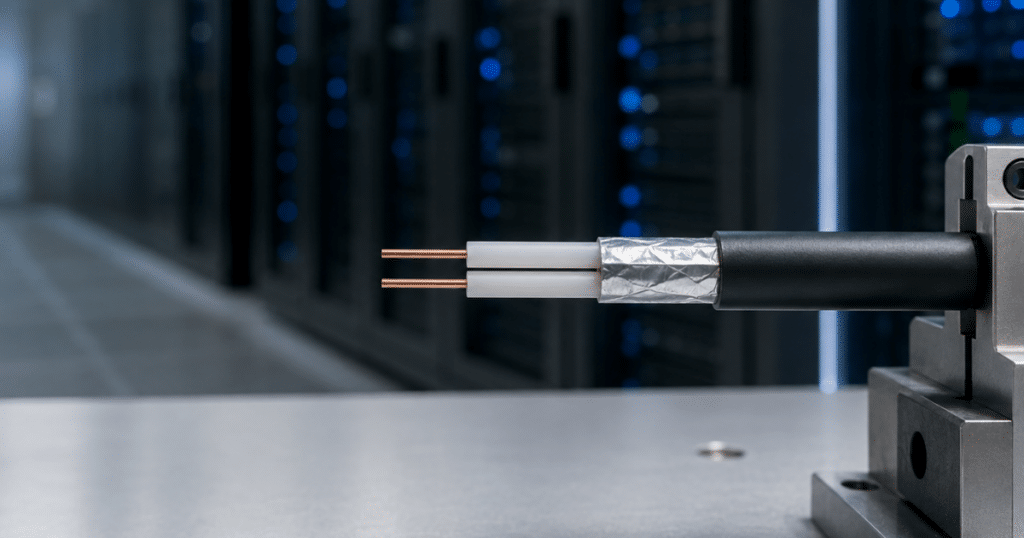
Data centers rely on a mix of cable types to move information between systems — coaxial, shielded and unshielded twisted pair, Twin Ax, and fibre optic, each suited to different connections across the network. What they share is a demand for speed and reliability that leaves almost no room for error. Server-to-server and server-to-switch links need to move data with minimal latency, and increasingly need to do so at the density AI workloads require. Tier 4 facilities — the fastest-growing category as AI pushes for maximum availability — are built around a target of 99.995% uptime.
At that level of reliability, a defect that would be a minor quality issue elsewhere becomes a real risk here. A stray fiber, an inconsistent strip length, a nicked conductor: any of these can degrade signal transfer or create a point of failure in a network that isn’t supposed to have one.
Where mechanical stripping struggles
Mechanical and manual stripping methods were built for a different era of cable processing, and they show their age quickly at data center scale and precision requirements:
- Blade wear. Physical blades dull and need regular replacement, and a worn blade changes the quality of every strip that follows it.
- Residue and damage. Mechanical contact can leave insulation residue behind or nick the underlying conductor — either can lead to poor data transfer.
- Bent conductors. Many mechanical processes require conductors to be bent to achieve a clean strip, working against the fine, dense wire types common in high-speed cabling.
- Inconsistent geometry. Holding consistent spacing between the cut foil and the cut dielectric is difficult by mechanical or manual means.
- Automation limits. Hyperscale build-outs need high, consistent yield across enormous volumes — something mechanical processes, largely built around handling one cable at a time, struggle to deliver.
None of these are new problems. They’re simply becoming more expensive at the volumes and reliability standards the current data center boom demands.
Why laser wire stripping is different
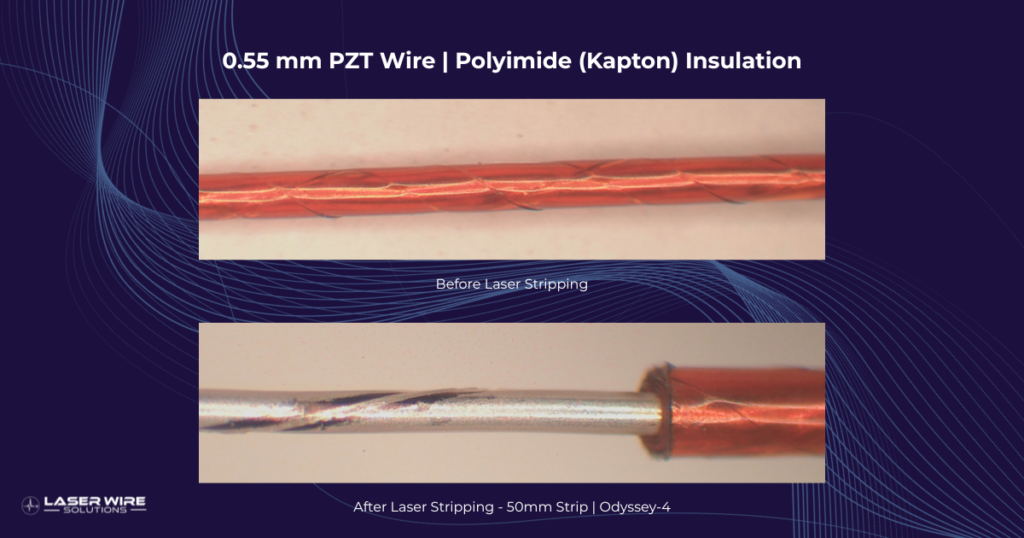
Laser wire stripping is a non-contact process: the laser’s wavelength is absorbed by the insulation while the underlying metal conductor reflects it, so the strip happens without a blade ever touching the wire. That difference changes both the economics and the reliability profile of cable processing:
- No nicked conductors. Removing physical contact removes the main cause of conductor damage during stripping.
- Precise, repeatable geometry. Strip length, depth, and spacing are controlled by software rather than by hand or a wearing blade — so strip one and strip one million look the same.
- Selective layer removal. Laser systems can selectively remove individual layers of complex, multi-conductor, and shielded cables, which matters for the coax and Twin Ax constructions common in data center networking.
- No wear parts. There’s no blade to replace mid-shift and no drift in quality as a consumable part ages.
- Built for automation. Consistent, software-controlled processing is what allows laser systems to scale to the high yield requirements of hyperscale production, rather than being limited to handling one cable at a time.
Matching the machine to the cable
At Laser Wire Solutions, this isn’t a theoretical case for lasers — it’s the specific problem our data center customers ask us to solve. Our Mercury 2 and Gemini 2 systems handle compact, bench-top processing of coax, twisted pair, and Twin Ax cables, while Mercury 4 is built for removing jackets from shielded multi-conductor cables at speed. All three are designed around the same principle: selective, software-controlled removal that holds its precision strip after strip.
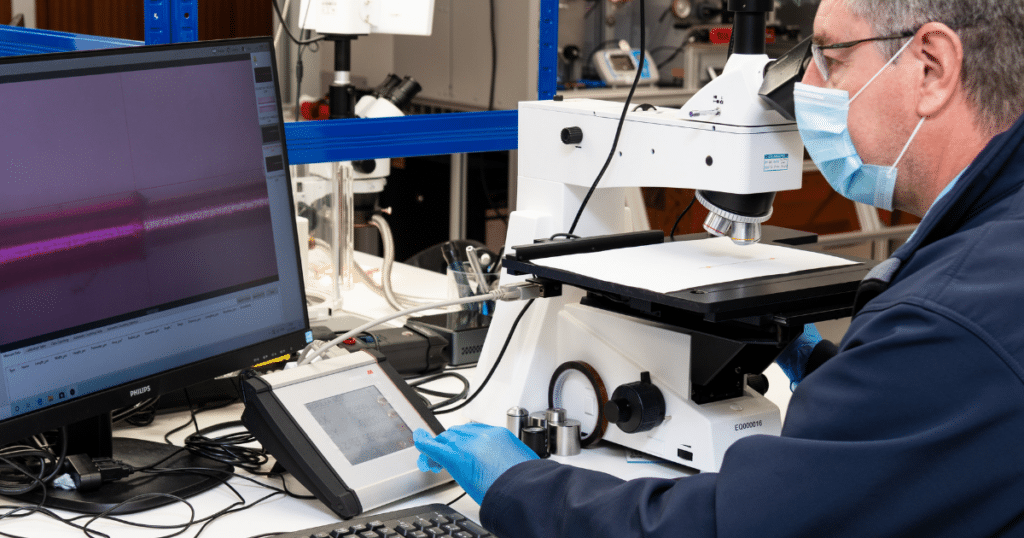
And because every data center customer’s cable mix is different, our in-house Applications Team works through the specific material, tolerances, and production challenge so the process is proven on your actual cable before it reaches your production line.
The takeaway
The data center industry is investing hundreds of billions of dollars to build faster, denser, more reliable infrastructure. Cable processing is a small part of that budget – but it’s a disproportionately large part of whether the network performs the way it’s supposed to. As build-outs accelerate and reliability standards climb, mechanical stripping is running out of room to keep up. Laser wire stripping was built for exactly this problem.
Want to see how laser processing handles your data center cabling? Send us the details and we’ll test it on our machines.