Electric vehicle cables are expected to carry high currents reliably while operating in an environment of vibration, temperature variation and repeated mechanical loading.
That makes cable preparation more important than it may initially appear.
During insulation stripping, even relatively small amounts of damage to the conductor can introduce a potential weak point into the cable assembly. A nick that appears insignificant immediately after stripping may become more important once the cable is terminated and subjected to the mechanical and thermal demands of vehicle operation.
For manufacturers processing high-voltage EV cable, preventing conductor nicking should therefore be considered part of the overall approach to cable reliability — not simply a cosmetic quality requirement.
What is conductor nicking?
Conductor nicking occurs when the conductor is cut, scored or otherwise mechanically damaged during removal of the surrounding insulation.
With stranded copper or aluminum cable, this may mean individual strands are partially cut or completely severed. With other conductor constructions, it may appear as a groove or reduction in the conductor surface.
Mechanical stripping processes typically rely on a blade penetrating sufficiently far into the insulation to separate it without reaching the conductor underneath.
The available process window can become increasingly important when there are variations in:
- insulation thickness
- conductor position or concentricity
- cable diameter
- blade condition
- strip depth
- material construction
A setting that successfully strips one cable may therefore have less tolerance when normal cable or process variation is introduced.
Why does a small conductor nick matter?
An EV cable is a complete mechanical and electrical system. The conductor does not only have to carry current — it also needs to maintain its integrity throughout assembly and subsequent vehicle operation.
A nick can affect that integrity in several ways.
Reduced conductor cross-section
Removing or damaging conductor material reduces the effective cross-sectional area at that point.
For a stranded cable, damage may affect only a small proportion of the total conductor. However, the remaining strands must continue to carry the electrical and mechanical load.
The electrical impact of a very small defect may initially be difficult to detect, but maintaining the intended conductor geometry becomes increasingly important in high-current applications.
ISO 19642 includes automotive cable requirements covering copper and aluminum cables for road-vehicle applications at voltages extending to 1,500 V DC, illustrating the demanding electrical environment in which modern vehicle cabling can operate.
A potential stress concentration
A nick also changes the geometry of the conductor.
Rather than distributing mechanical forces through an undamaged strand, the damaged area can become a point at which stresses are concentrated.
This becomes particularly relevant when a cable experiences repeated movement or vibration.
The defect does not necessarily cause an immediate failure. Instead, it can reduce the margin available to the cable when it is subsequently exposed to mechanical loading throughout its service life.
Automotive component test methods recognize that electrical connections may need to withstand combined vibration and thermal cycling, reflecting the type of environmental loading encountered within vehicles.
Increased vulnerability to fatigue
EV cables can experience vibration from the road, drivetrain and surrounding vehicle systems.
They can also expand and contract as temperatures change.
Where a conductor has already been weakened during stripping, repeated mechanical loading may encourage further deterioration at the damaged point.
This makes the condition of the conductor at the end of the stripping process particularly important: cable preparation establishes the starting condition from which the finished assembly must withstand its subsequent service environment.
Conductor nicking can also affect the termination
The stripped section of an EV cable rarely exists in isolation. It is normally being prepared for the next manufacturing operation.
Depending on the application, this could include:
- crimping
- welding
- soldering
- connector assembly
- busbar termination
- another joining process
This makes conductor integrity particularly important.
If strands have been damaged or removed during stripping, the conductor entering the termination may no longer have the geometry expected when the joining process was developed.
For example, missing or damaged strands can alter how material is distributed within a crimp. They may also change the amount and condition of material presented to a welding operation.
The stripping process can therefore have consequences beyond the strip itself.
Reliable termination starts with repeatable cable preparation.
Why EV cable construction makes stripping challenging
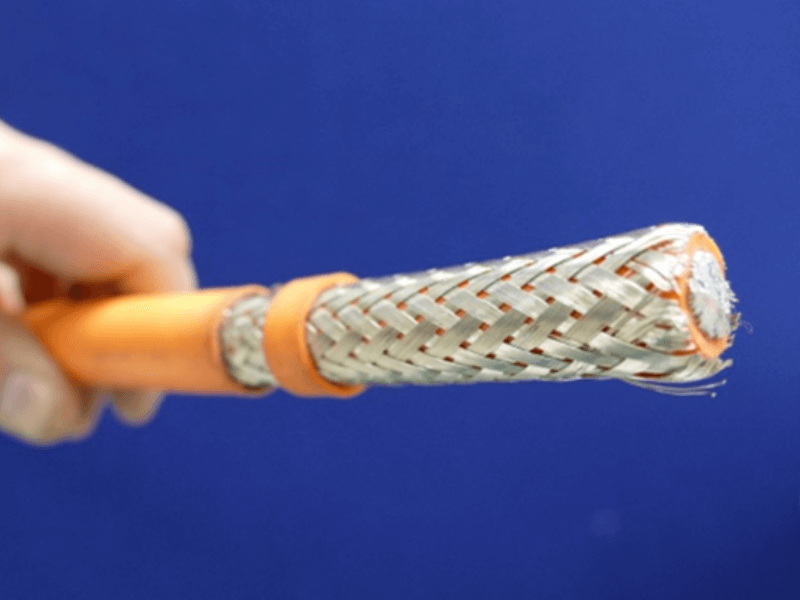
Modern EV cables are not necessarily simple jacket-and-conductor constructions.
Depending on their function, they may include combinations of:
- thick outer jackets
- shielding
- foil layers
- braided screens
- dielectric materials
- multiple insulation layers
- large copper or aluminum conductors
Each layer may need to be removed to a defined position while preserving the material underneath.
As cable constructions become more complex, the stripping operation becomes a selective material-removal process rather than simply cutting through an outer jacket.
This creates an important manufacturing question:
How can the required insulation be removed consistently without compromising the conductor underneath?
Why mechanical stripping can create a limited process window
Mechanical wire stripping remains an effective solution for many applications, but it fundamentally depends on controlling the position of a cutting tool relative to the conductor.
For large-volume EV cable production, factors such as blade wear, cable dimensional variation and conductor eccentricity can therefore influence process consistency.
Increasing the cutting depth may help achieve reliable insulation separation, but it also brings the blade closer to the conductor.
Reducing the depth protects the conductor but may increase the likelihood that the insulation is not completely cut.
The result can be a relatively narrow processing window when the material requiring removal sits immediately against a surface that must remain undamaged.
Using laser stripping to remove the blade from the process
Laser wire stripping approaches the problem differently.
Rather than physically cutting through insulation with a blade, laser energy is used to remove or separate the polymer material.
The process is non-contact, meaning there is no cutting edge that needs to be positioned immediately alongside the conductor.
For suitable cable constructions, the laser wavelength can be selected so that the insulation absorbs the laser energy while the underlying metallic conductor responds very differently.
The objective is selective material removal: efficiently processing the insulation without mechanically contacting the conductor.
This can be particularly valuable where preventing conductor damage is a critical process requirement.
Repeatability matters as much as the individual strip
Avoiding a nick on one cable is not the same as establishing a reliable production process.
For EV manufacturers and cable processors, the more important question is whether conductor integrity can be maintained across thousands or millions of processing cycles.
That requires consideration of:
- cable tolerances
- material variation
- positioning
- strip length
- strip geometry
- process parameters
- equipment condition
- inspection criteria
A controlled laser process allows these parameters to be incorporated into a defined processing recipe rather than relying heavily on operator judgement or mechanical blade adjustment.
This becomes increasingly valuable as manufacturers move towards higher levels of production automation.
How much conductor nicking is acceptable?
There is no single percentage or depth of conductor nicking that can automatically be considered acceptable for every EV cable.
Acceptance criteria should be determined by the cable, termination, customer requirements and applicable manufacturing specifications.
More importantly, manufacturers should consider whether accepting a certain level of conductor damage is necessary in the first place.
If the stripping process can be designed to avoid mechanical interaction with the conductor, it may be possible to reduce one source of variation before the termination process even begins.
Process validation can then focus on demonstrating that the specified strip is produced consistently while the underlying conductor remains within the required condition.
Conductor integrity starts with cable preparation
The reliability of an EV electrical connection is influenced by every process that comes before it.
Stripping may represent only a small part of the overall cable manufacturing sequence, but it determines the condition of the conductor presented to the next operation.
A damaged conductor may still pass an initial visual inspection or even perform correctly during early testing. However, EV cable assemblies must be designed for much longer-term exposure to electrical load, temperature change and mechanical stress.
Preventing damage during preparation gives the downstream termination the best possible starting point.
For EV cable manufacturers, the question should therefore not simply be:
“Can we remove the insulation?”
It should be:
“Can we remove the insulation repeatedly while maintaining the integrity of the conductor underneath?”
Laser stripping for EV and high-voltage cable
Laser Wire Solutions develops laser stripping processes for a wide range of automotive and high-voltage cable constructions.
By using non-contact laser processing, insulation can be selectively removed without introducing a mechanical blade to the conductor surface.
Process development can be carried out using the customer’s actual cable to determine the appropriate laser technology, processing parameters and automation approach before equipment is introduced into production.
For larger EV and high-voltage cables, the Mercury Series provides scalable laser stripping solutions designed for demanding cable-processing applications.
If conductor nicking, strip consistency or processing complex EV cable constructions is creating a challenge within your production process, contact the Laser Wire Solutions team to discuss your application.