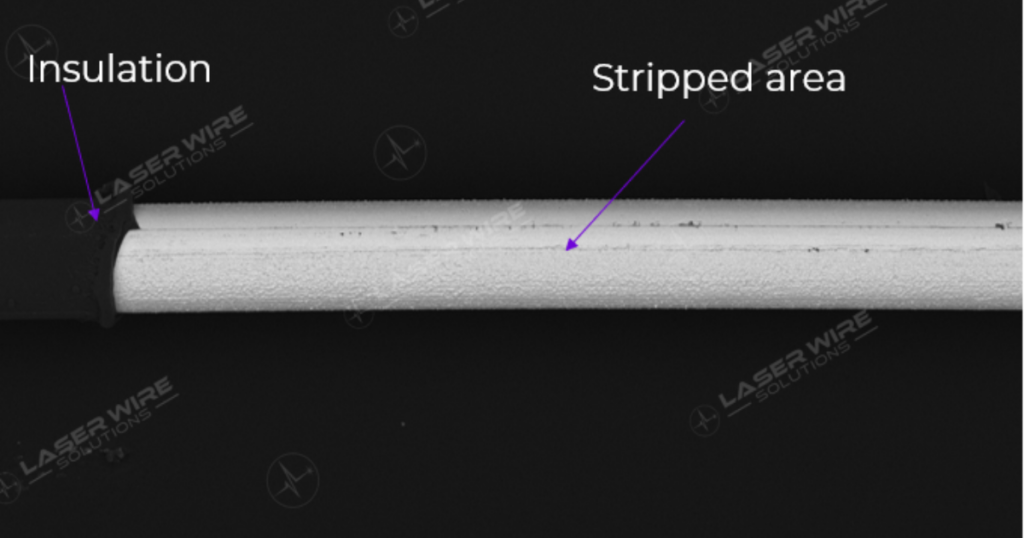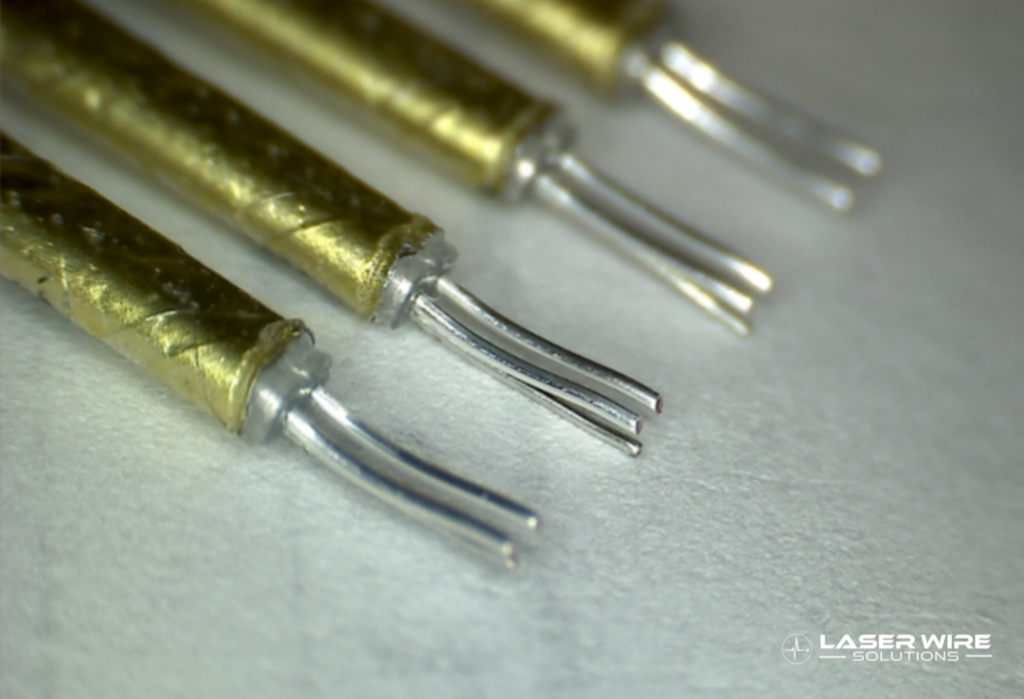
Micro-coaxial cable is used in a wide range of medical device applications where compact design, signal integrity and reliable assembly are critical. It is commonly found in ultrasound probes, catheter-based devices, endoscopy systems, advanced sensors and other high-density medical cable assemblies.
Although micro-coax cable is small, the stripping process can be highly demanding.
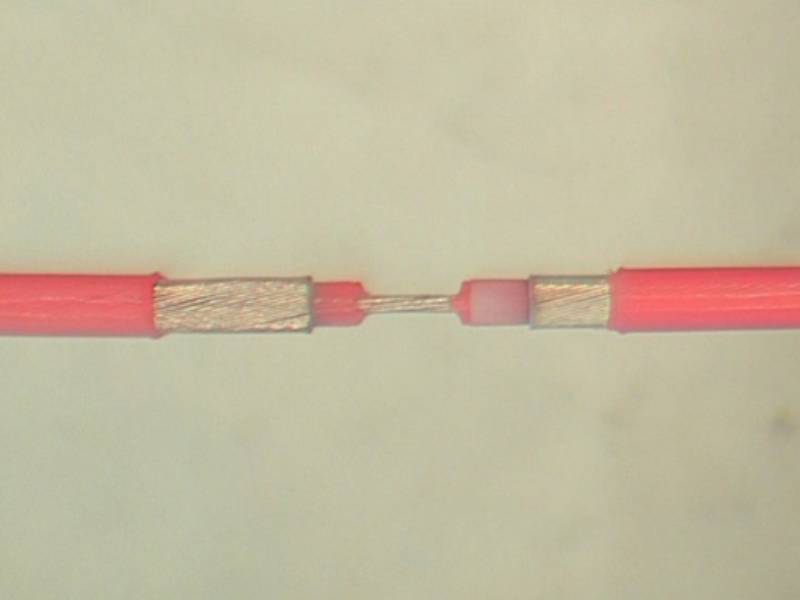
Each cable may include multiple delicate layers, including an outer polymer jacket, metallic shield or braid, dielectric insulation and a fine centre conductor. Preparing these layers accurately is essential for reliable termination, assembly and device performance.
At this scale, traditional mechanical stripping methods can struggle to deliver the level of control required.
Laser stripping offers a non-contact alternative for manufacturers that need clean, repeatable micro-coax cable preparation with reduced risk of damage to the cable structure.
What is micro-coaxial cable?
Micro-coaxial cable is a small-diameter coaxial cable designed to transmit electrical signals while protecting signal quality in compact assemblies.
A typical micro-coax cable may include:
- An outer polymer jacket
- A metallic shield, braid or foil layer
- Dielectric insulation
- A centre conductor
This layered construction helps protect signal performance, but it also makes the cable difficult to strip. Each layer has a different material response, thickness and sensitivity to damage.
For medical device manufacturers, this creates a clear process challenge: how do you remove or expose the correct layer without damaging the layers beneath?
Why is micro-coax cable difficult to strip?
Micro-coax cable is difficult to strip because it combines small dimensions with multiple material layers. The stripping process must be accurate enough to remove one layer while protecting the next.
Common micro-coax stripping challenges include:
- Controlling strip depth on very small cable diameters
- Removing the outer jacket without disturbing the shield
- Cutting or exposing shield layers without damaging the dielectric
- Stripping dielectric insulation without marking the centre conductor
- Maintaining repeatable results across batches
- Reducing operator variation during manual processing
Mechanical blade stripping can work well for many conventional wires and cables. However, with fine micro-coax cable, blade contact can introduce risk. If the blade is set too deep, it may damage the shield, dielectric or conductor. If it is set too shallow, the strip may be incomplete.
This is especially important in medical device manufacturing, where cable damage can affect assembly quality, electrical performance and process validation.
How does laser stripping micro-coax cable work?
Laser stripping uses focused laser energy to remove selected cable layers without mechanical blade contact.
For micro-coax cable, different laser wavelengths can be used depending on the material being processed. CO₂ and UV laser technology can support different stages of the stripping process, including:
- Controlled outer jacket removal
- Shield cutting or shield exposure
- Dielectric stripping
- Centre conductor exposure
The aim is to match the laser process to the cable construction and material response. This allows each layer to be processed with greater control than a single mechanical cutting method can often provide.
Because laser stripping is non-contact, there is no blade pressing into the cable. This helps reduce the risk of mechanical deformation, blade wear and operator-dependent adjustment.
CO₂ and UV laser stripping for layered cable constructions
Micro-coaxial cable often contains a combination of polymer insulation and metallic shielding. These materials do not all respond in the same way to one laser wavelength.
That is why wavelength selection matters.
CO₂ laser technology is commonly used for processing certain polymer insulation materials. UV laser technology can provide a different interaction with materials and is often used where fine control is required.
For layered micro-coax constructions, using the right laser wavelength for the right material can support more controlled processing of:
- Polymer jackets
- Shield layers
- Dielectric insulation
- Fine conductor exposure
This is particularly useful where the cable assembly requires multiple strip stages or where each layer needs to be prepared to a defined length.
Benefits of laser stripping micro-coax cable
Laser stripping can help medical device manufacturers improve control, consistency and repeatability when preparing fine coaxial cable assemblies.
Key benefits include:
Non-contact processing
Laser stripping removes material without a mechanical blade contacting the cable. This helps reduce the risk of crushing, nicking or deforming delicate cable layers.
Improved repeatability
Once the correct process parameters are developed, the same laser recipe can be repeated across production batches. This supports more consistent results than manual or operator-dependent stripping methods.
Better layer control
Micro-coax cable requires accurate processing of individual layers. Laser stripping can be developed around the cable construction, material type and required strip geometry.
Reduced blade-related issues
Mechanical blades can wear, drift or require frequent adjustment. Laser processing removes the cutting blade from the process, reducing blade maintenance and setup variation.
Support for process validation
For medical device manufacturers, repeatability and process control are critical. Laser stripping can support a more controlled and documented preparation process.
Where is laser stripping used in medical micro-coax applications?
Laser stripping may be suitable for micro-coaxial cables used in:
- Ultrasound probes
- Catheter-based devices
- Endoscopy systems
- Advanced medical sensors
- Electrophysiology devices
- Neurovascular devices
- High-density medical cable assemblies
- Fine coaxial cable interconnects
In these applications, precise cable preparation is important because the cable may be part of a high-value assembly where signal quality, reliability and repeatability matter.
Is laser stripping suitable for every micro-coax cable?
Not every cable construction is suitable for laser stripping.
The suitability of laser processing depends on the cable materials, cable geometry, layer thickness, shield construction and the required strip specification. This is why application validation is an important first step.
A sample evaluation can help determine:
- Which laser wavelength is most suitable
- How each cable layer responds to laser processing
- Whether the required strip quality can be achieved
- What process parameters are needed
- Whether the process can be repeated consistently
For medical device manufacturers, this helps reduce risk before committing to a production process.
Validate your micro-coax stripping application
If you are working with micro-coaxial cable, fine coaxial cable or delicate medical cable assemblies, Laser Wire Solutions can help assess whether laser stripping is suitable for your application.
Our application process helps determine the correct laser parameters for your material and cable construction. This means the process can be developed before machine installation, with validated recipes ready to support production.
The goal is simple:
Clean stripping.
Repeatable results.
Less risk to the cable.
Frequently Asked Questions
What is the best way to strip micro-coaxial cable?
The best stripping method depends on the cable construction, materials and required strip quality. For fine medical micro-coax cable, laser stripping can offer a non-contact alternative to mechanical blade stripping, helping reduce the risk of damage to delicate cable layers.
Why is micro-coax cable difficult to strip?
Micro-coax cable is difficult to strip because it contains multiple small and delicate layers, including an outer jacket, shield, dielectric and centre conductor. Each layer must be processed without damaging the layer beneath.
Can laser stripping remove the jacket from micro-coax cable?
Yes, laser stripping can be used to remove selected polymer jacket materials from micro-coax cable, depending on the material type, cable construction and required strip specification.
Can laser stripping be used for medical device cables?
Yes, laser stripping is used for a range of medical device cable applications where precise, repeatable and non-contact insulation removal is required.
Why use CO₂ and UV lasers for micro-coax cable stripping?
Different cable layers and materials respond differently to laser wavelengths. CO₂ and UV laser technology can be used to process different materials within layered cable constructions, supporting controlled jacket removal, shield processing and dielectric stripping.
How do I know if laser stripping is suitable for my micro-coax cable?
The best way to confirm suitability is through application validation. This allows the cable construction, materials and strip requirements to be tested so the correct process parameters can be developed.