Choosing a laser wire stripping machine is about more than comparing laser type, strip length, wire diameter or cycle time.
When working with tightly controlled production processes, the quality of support available around the equipment can be just as important as the machine itself.
A laser stripping system may remain in production for many years. During that time, new wire types may be introduced, production volumes may increase, operators may change and processes may need to be transferred, optimized or revalidated.
So, when comparing laser wire stripping suppliers, what should you expect from their customer support?
1. Support should start before you choose a machine
One of the most important questions to ask a laser system supplier is:
Will you help me develop the process, or simply recommend a machine?
The correct laser technology depends heavily on what needs to be processed.
Factors can include:
- insulation material
- conductor material
- wire diameter
- number of insulation layers
- strip geometry
- required strip length
- allowable thermal input
- production volume
- downstream joining or termination requirements
For example, CO₂, UV and femtosecond lasers interact with materials differently. Selecting a system purely from a specification sheet can therefore result in unnecessary compromise.
A good laser wire stripping supplier should be able to evaluate the application first and determine the most appropriate processing method.
At Laser Wire Solutions, application development can begin before an equipment specification is finalized. Our engineering teams work with customers to establish the required result, identify the appropriate laser process and develop suitable processing parameters around the component.
This means the conversation can start with:
“This is the component we need to manufacture.”
Rather than:
“Which machine do we need to buy?”
2. Can the supplier prove the process works?
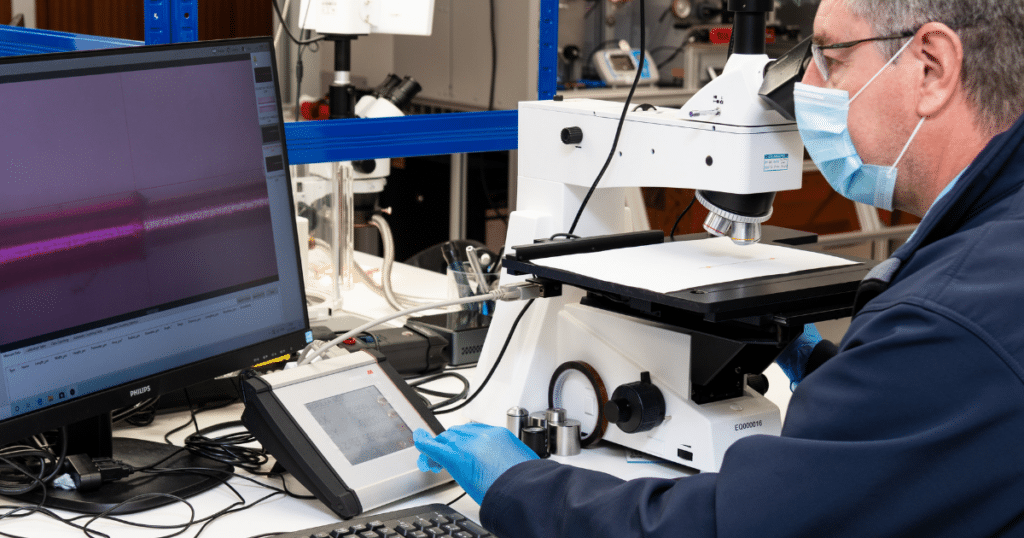
Sample testing is useful, but for many applications it should only be the beginning.
A successful strip needs to be evaluated against the requirements of the finished component.
Depending on the application, this may include assessing:
- insulation removal
- residue
- conductor integrity
- strip position
- dimensional accuracy
- repeatability
- surface condition
- downstream termination performance
This becomes particularly important for fine wire and medical device applications, where even small variations in preparation can affect subsequent processes such as welding, soldering, crimping or bonding.
The supplier should therefore be able to explain not only whether the laser can remove the insulation, but also how the resulting process will be controlled and repeated in production.
3. Ask what application development support is available
Not every laser stripping requirement fits neatly within a standard machine configuration.
A new application may require:
- custom tooling
- specialist fixtures
- vision systems
- automated handling
- unusual strip geometries
- multi-stage processing
- integration with other manufacturing processes
This is where the difference between an equipment supplier and an application partner becomes much clearer.
If a process needs to evolve, can the supplier’s engineers work with you to develop it?
Laser Wire Solutions develops both standard and application-specific laser processing solutions. This allows the system, tooling, process and automation strategy to be considered together rather than treating the laser as an isolated piece of equipment.
4. What happens during installation and production ramp-up?
Delivery of the machine should not represent the end of the project.
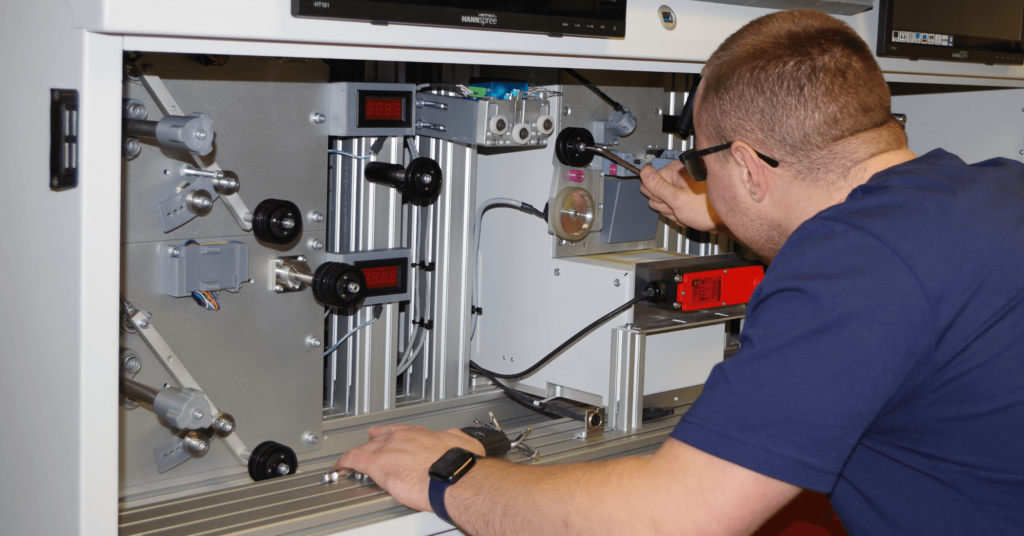
Installation and training are particularly important for laser wire processing because operators need to understand both the equipment and the process being controlled.
Support should cover areas such as:
- machine installation
- operator training
- recipe selection
- fixture setup
- routine maintenance
- process monitoring
- troubleshooting
- safe operation
Where appropriate, production equipment should also undergo acceptance testing before it reaches the customer’s manufacturing environment (Factory Acceptance Test or FAT).
For more complex projects, this can provide an opportunity to demonstrate that the agreed process and machine configuration perform as expected before installation.
5. How easy is it to get technical help?
Eventually, every production environment encounters questions.
A fixture may need adjusting.
A new cable construction may be introduced.
A process parameter may need reviewing.
An operator may need additional training.
A component may suddenly behave differently from a previous batch.
When comparing suppliers, it is therefore worth asking who actually provides technical support.
Is support limited to basic machine troubleshooting, or can you access engineers who understand the underlying laser process?
At Laser Wire Solutions, service, engineering and applications expertise work closely together. This is particularly valuable when a production issue is application-related rather than simply a mechanical or electrical machine fault.
6. Can the supplier support you when your product changes?
Manufacturing processes rarely remain unchanged forever.
A program may initially require one wire construction but later move to another insulation, diameter or strip geometry.
Production volumes can increase.
Automation may become necessary.
A second manufacturing site may need to adopt the same process.
The original laser system may therefore need to accommodate requirements that were not anticipated when it was first purchased.
Before investing in equipment, ask whether your supplier can help you:
- develop additional processes
- introduce new wire types
- create new fixtures
- optimize cycle time
- scale production
- integrate automation
- transfer processes between sites
Long-term application support can significantly extend the usefulness of the original equipment investment.
7. What if you are not ready to purchase equipment?
This can be an overlooked part of the supplier comparison.
A laser process may be technically successful while the business case for bringing it in-house is still developing.
Manufacturers may need time to:
- validate a new product
- establish production demand
- secure capital expenditure
- complete internal qualification
- develop automated assembly
- build internal laser processing expertise
Purchasing equipment immediately may therefore not always be the best first step.
Laser Wire Solutions can also support qualifying medical device applications through its Medical Device Component Supply service.
Instead of immediately purchasing laser equipment, manufacturers can outsource the laser processing stage while the product or production requirement develops.
This creates a potential pathway from:
feasibility → process development → outsourced production → equipment purchase or automation
rather than requiring every project to begin with capital investment.
8. Does the supplier understand your industry?
The required level of support can vary considerably by industry.
A high-volume automotive cable manufacturer may have very different priorities from a medical device engineer working with a 0.1 mm wire.
In highly controlled sectors, questions may extend beyond whether the machine can perform the process.
Engineers may also need to consider:
- repeatability
- process monitoring
- traceability
- parameter control
- equipment qualification
- process validation
- change control
- material integrity
Choosing a supplier familiar with those requirements can make process development significantly easier.
Laser Wire Solutions works extensively with manufacturers in medical device, aerospace, automotive, data communications and other high-reliability industries where wire preparation quality is critical.
9. What should you ask a laser wire stripping supplier?
Before choosing a supplier, consider asking:
Can you test my actual wire or cable?
How will you determine which laser technology is appropriate?
Can you demonstrate conductor integrity after stripping?
What happens if my application requires custom tooling or automation?
Can you help develop the process before I purchase equipment?
What training is included?
Who provides technical support after installation?
Can you help if we introduce a new wire construction later?
What preventative maintenance and servicing is available?
Can you support production while we are validating or scaling the process?
The answers can reveal much more about the likely long-term relationship than the machine specification alone.
Choosing more than a laser stripping machine
The best laser wire stripping system is not necessarily the machine with the longest specification sheet.
It is the system that reliably produces the required result within the customer’s manufacturing environment; supported by the people, processes and engineering knowledge needed to keep it performing.
That is why we believe laser wire stripping should be approached as an application rather than simply an equipment purchase.
At Laser Wire Solutions, we support customers from initial feasibility and process development through equipment selection, custom engineering, installation, training and ongoing production support.
Whether you are investigating laser stripping for the first time, developing a difficult wire-processing application or looking to scale an existing process, our applications team can help determine the most appropriate route forward.
Talk to our team about your wire processing application.