For process engineers, selecting a manufacturing technology is rarely about choosing the most advanced option. It is about finding the process that consistently produces the required feature, on the required material, at an acceptable production rate.
Femtosecond laser micromachining becomes particularly valuable when conventional machining or longer-pulse laser processes reach their practical limits. The technology enables highly controlled material removal with minimal thermal impact, opening new possibilities for micro-scale features, complex material combinations and demanding precision applications.
But when is a femtosecond laser actually the right choice?
When Does Femtosecond Laser Micromachining Make Sense?
Femtosecond lasers deliver energy in extremely short pulses. This allows material to be removed before significant heat can spread into the surrounding area, reducing the thermal effects associated with longer-pulse processing.
For a process engineer, this capability is most relevant when the application involves:
- Very small or tightly controlled features
- Heat-sensitive materials
- Multi-layer components requiring selective material removal
- Materials that are difficult to process mechanically
- Geometries where tool access is restricted
- Components where mechanical force is undesirable
- Tight requirements for edge quality and repeatability
However, femtosecond processing should not be specified simply because high precision is required. If another technology can reliably meet the specification at a better cycle time or lower overall process cost, that may be the more appropriate solution.
The starting point should always be the application.
Start With the Material and Feature
Two components that appear similar can require very different femtosecond laser processes.
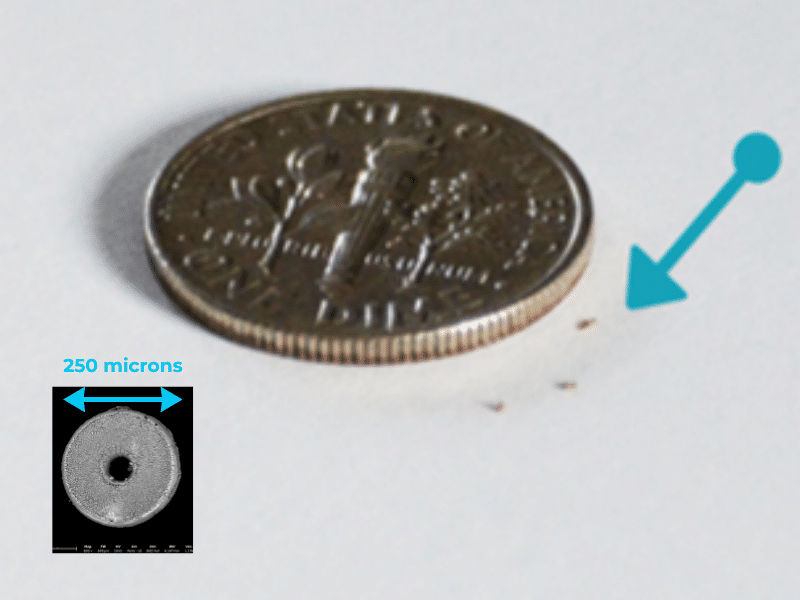
Material composition, thickness, feature geometry and tolerance all influence how the process should be configured. A micron-scale hole through a polymer-metal composite, for example, presents a different challenge from selectively removing a fluoropolymer coating or creating a precision feature in a ceramic component.
Process engineers should define the critical requirements before evaluating equipment:
- What material or combination of materials must be processed?
- What feature size and tolerance are required?
- Is the process selective between different material layers?
- What level of thermal impact is acceptable?
- What constitutes an acceptable edge or surface finish?
- What cycle time is required in production?
These questions help determine not only whether femtosecond laser micromachining is appropriate, but also the type of laser and system architecture required.
Process Parameters Are Only Part of the Equation
Developing a reliable femtosecond process involves considerably more than selecting pulse energy and pressing start.
Wavelength, fluence, repetition rate, spot size, pulse overlap and scanning strategy can all influence the result. The optimum combination depends on how the target material interacts with the laser energy and on the geometry being created.
The wider machine configuration is equally important.
Motion control, beam delivery, part fixturing, vision and automation can determine whether a successful laboratory process becomes a repeatable manufacturing process. A technically achievable feature has limited value if component positioning varies, the process cannot be inspected reliably or production throughput cannot meet demand.
This is why application development should come before machine specification.
Moving From Feasibility to Production
A successful sample proves that a feature can be created. It does not automatically prove that the process is ready for manufacturing.
Moving from initial feasibility to production requires understanding the process window. Engineers need to know how changes in material, positioning and process parameters affect the final result. For regulated or high-value manufacturing, this becomes particularly important when establishing repeatability and supporting validation.
The system should then be configured around the proven process.
At Laser Wire Solutions, this application-led approach is central to femtosecond process development. Rather than treating the laser source as the complete solution, the objective is to develop the process first and then define the laser source, optics, motion, vision and automation required to deliver it consistently.
For manufacturers evaluating femtosecond laser micromachining, the most useful first question is therefore not, “Which femtosecond laser should we buy?”
It is, “What process do we need to achieve?”
Frequently Asked Questions
What is femtosecond laser micromachining?
Femtosecond laser micromachining uses ultrashort laser pulses to create small, precise features through controlled material removal. The short interaction time helps limit heat transfer into the surrounding material.
What materials can be micromachined with a femtosecond laser?
Femtosecond lasers can process a broad range of materials, including polymers, metals and ceramics. The appropriate wavelength and process parameters depend on the material and required result.
What features can femtosecond lasers create?
Applications can include micro-holes, precision cuts, slots, surface structures and selectively ablated areas. The achievable geometry depends on the material, optical configuration, motion system and process requirements.
Does every precision application require a femtosecond laser?
No. The most appropriate laser technology depends on the material, feature requirements, acceptable thermal effects, throughput and economics. Femtosecond processing is most valuable when other processes cannot reliably achieve the required result.
Can femtosecond micromachining be automated?
Yes. A production system can incorporate motion control, vision, automated loading and other technologies depending on the application and required production volume.
How do you develop a femtosecond laser process?
Development typically starts with the material and required feature. Testing is then used to establish suitable laser parameters and processing strategies before the complete machine configuration and production process are defined.
Conclusion
Femtosecond laser micromachining can solve manufacturing challenges that are difficult to address with conventional machining and longer-pulse laser technologies. Its value, however, depends on applying the technology to the right problem.
For process engineers, successful implementation starts by defining the material, feature, tolerance and production requirements. From there, process development can establish whether femtosecond technology provides the required capability and what system configuration is needed to deliver a repeatable, scalable manufacturing process.